Elasto Proxy makes unmanned ground vehicle (UGV) parts for sealing and insulation. This article provides an engineering-level overview of how and where these parts are used.
Unmanned ground vehicles (UGVs) need rubber and plastic parts that can withstand harsh terrain, extreme temperatures, dust, chemicals, water, shock, and vibration. Whether it’s a small, tracked robot for a farm or a large autonomous logistics carrier for an army, sealing and insulation must protect onboard electronics, drivetrains, sensors, and payloads.
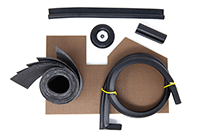
Elasto Proxy supports UGV prototyping and production in Canada, the United States, and Europe. We supply custom rubber and plastic parts for unmanned ground vehicles that are used in military or civilian applications. Examples include rubber seals and gaskets, thermal insulation, vibration mounts, molded boots, and EMI shielding.
Keep reading to learn more, and contact Elasto Proxy if you’re designing an unmanned ground vehicle and need custom sealing and insulation solutions. In addition to custom fabrication, we offer valued-added services like help with material selection: a key consideration in UGV part design because of the large number of materials that are available.
The terms agricultural robots and agricultural UGVs are sometimes used interchangeably.
The Unmanned Ground Vehicle Environment
UGVs face different environmental and mechanical challenges than unmanned surface vehicles (USVs) and unmanned underwater vehicles (UUVs). Instead of hydrostatic pressure or saltwater corrosion, an unmanned ground vehicle must withstand:
- Dust, sand, and particulate intrusion, especially in desert or mining environments
- Mud and water, including high‑pressure washdowns for periodic cleaning
- Shock and vibration from uneven terrain, curb impacts, and tracked or wheeled propulsion
- Thermal cycling from cold starts, engine heat, solar loading, and winter operation
- Chemical exposure to fuels, oils, hydraulic fluids, and cleaning agents
- Electromagnetic interference (EMI) from radios, engines, and power electronics
- Mechanical abrasion from rocks and debris
That’s why rubber and plastic UGV parts must provide:
- Ingress protection (e.g., IP67, IP68, IP69) for electronics and enclosures
- Thermal stability across wide temperature ranges
- Chemical resistance to oils, fuels, solvents, and cleaning agents
- Vibration damping to protect sensors and electronics
- EMI shielding for communication and navigation systems
- Mechanical durability under repeated shock loading

Chassis, Hull, and Access Panel Sealing
The UGV chassis or hull is a load-bearing structure that carries the internal combustion engine or electric battery, onboard electronics, and mission payloads. It requires access panel and door gaskets, bulkhead and cable penetration seals, and modular payload seals.
Access Panel and Door Gaskets
UGVs have multiple access points for maintenance, battery swaps, and payload installation. They need gaskets that resist compression set and maintain their material properties. Commonly used gasket materials include:
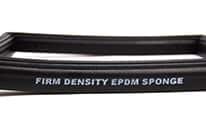
- EPDM sponge for sunlight, ozone, and weather resistance
- Silicone rubber for stable properties across extreme temperature ranges
- Fluorosilicone for fuel, oil, and solvent resistance at extreme temperatures
- Nitrile (NBR) for resistance to petroleum-based oil, greases, and lubricants
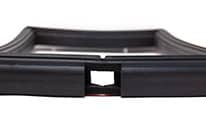
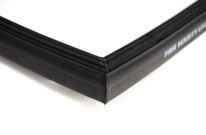
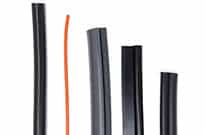
Elasto Proxy fabricates access panel and door gaskets from extrusions that we water jet cut to size and then join at the corners for leak-free performance.
Bulkhead and Cable Penetration Seals
UGVs route power, data, and sensor cables through bulkheads and sealed compartments.
- Penetration seals prevent dust and water ingress while allowing strain relief.
- Compression cable glands secure, seal, and terminate electrical cables.
- Molded boots protect connectors, cables, and other components.
- Bulkhead O‑rings prevent leakage and withstand pressure fluctuations.
- Grommets protect cables and wires as they pass through panels.
- Strain-relief bushings lock cables in place to prevent tension or bending.
Thermoplastic elastomers (TPEs) are often used for molded boots because they’re recyclable and lightweight Bulkhead O-rings are often made of EPDM, silicone, or FKM, a fluoropolymer that’s better known by its trade name, Viton.
Modular Payload Bay Seals
Many UGVs have modular mission bays for sensors, robotic arms, or cargo modules. These bays need seals and insulation that can withstand shock, vibration, and repeated assembly/disassembly cycles. Parts include:
- Compression seals for static joints
- Shear-resistant seals for dynamic loading

Drivetrain, Suspension, and Propulsion System Sealing
UGV propulsion systems produce high heat and are regularly exposed to chemicals and vibrations. Rubber and plastic parts can provide protection against contamination and mechanical stress. Motor and gearbox seals, vibration isolators and motor mounts, and cooling system hoses and seals are used.
Motor and Gearbox Seals
UGV motors and gearboxes must remain protected from dust, mud, and water.
- PTFE‑reinforced lip seals provide low‑friction shaft sealing.
- Viton O‑rings combine chemical and high-temperature resistance.
- Nitrile (NBR) seals resist petroleum-based oils.
- Custom‑molded boots protect CV joints and articulated drivetrains.
Vibration Isolators and Motor Mounts
Unmanned ground vehicles experience continuous vibrations from terrain and propulsion, but excessive vibration can degrade sensor accuracy and reduce the lifespan of electronics. Rubber-to-metal vibration isolators and motor mounts reduce these vibrations. They’re typically made from:
- Natural rubber for high damping
- EPDM for weather resistance
- Silicone for high‑temperature environments
Cooling System Hoses and Seals
Hybrid and high‑power electric UGVs require liquid cooling for motors, inverters, and battery packs.
- Silicone hoses transport coolants.
- Viton O‑rings seal pump housings.
- Polyurethane tubing provides abrasion resistance.

Sensors, Electronics, and Control System Protection
The performance of an unmanned vehicle depends on sensor-based systems. To protect radar, LiDAR, cameras, GPS, IMUs, and environmental sensors, different types of sealing and insulation are used. This includes EMI shielding for protection against electromagnetic interference (EMI).
Electronics Enclosure Gaskets
UGV electronics are housed in enclosures that may need to provide specific levels of Ingress Protection (IP) against dust, water splash, and high‑pressure washdowns. IP-rated gaskets may be used in motor controllers, navigation computers, radios, and sensor processing units.
- Closed‑cell EPDM provides moisture resistance.
- Silicone foam delivers thermal stability.
- UL94‑rated materials resist the spread of flame.
Cable Boots and Wire Harness Protection
UGV wiring harnesses must withstand flexing, abrasion, and environmental contaminants. Protective rubber and plastic parts include molded cable boots, heat-shrink tubing, overmolded strain-relief connectors, and abrasion-resistant conduit systems.
Optical and Sensor Window Sealing
Cameras and optical sensors have clear windows made of optical-grade plastic. Gaskets made of low-outgassing silicones won’t release volatile compounds that could cloud them. To reduce vibration blur, a problem that occurs when a camera shakes, vibration mounts are used.
EMI Shielding Gaskets
UGVs contain or operate near high‑power radios, GPS antennas, and digital motor controllers that produce electronic “noise”. Electrically conductive silicones are fabricated into gaskets that provide environmental sealing and EMI shielding for enclosure doors, antenna housings, and RF-sensitive modules.

Battery and Power System Protection
Hybrid or all-electric UGVs use lithium‑ion or lithium‑polymer battery packs that require rubber and plastic parts for sealing, insulation, and mechanical protection.
- Battery enclosure gaskets seal-out the environment.
- Thermal insulation protects electronics from battery heat.
- Vent seals prevent damage caused by pressure differentials.
- Cable channels guide and protect wires and cables.
- Strain reliefs secure cables and prevent damage from pulling or twisting.
Payload and Mission System Sealing
UGV payloads include robotic arms, explosive ordnance disposal (EOD) tools, environmental sensors, logistics modules, and weapon systems. Each requires specialized sealing and insulation.
Here are two examples.
- Robotic arms and actuators use rod seals and wipers, bellows and boots, and hydraulic and pneumatic seals. These components protect actuators from dust, mud, and abrasion.
- Sensors and communications payloads use compression seals, quick-disconnect b boots, and EMI gaskets.
Launch, Transport, and Safety Components
Unmanned ground vehicles interact with transport vehicles, charging or fueling stations, and human operators. They need rubber and plastic parts that support safety and durability.
- Rubber bumpers absorb impact from collisions.
- Rubber mats provide anti-slip surfaces for maintenance personnel.
- Plastic fairings reduce wind drag to promote fuel efficiency
- Plastic covers enclose and protect charging ports and connectors
Materials include EPDM, natural rubber, ABS, and polycarbonate.
Learn more about what we do an how we can support your project.
Ask Elasto Proxy for UGV Parts
Engineers who design UGVs need a manufacturing partner—not just a parts supplier. Elasto Proxy is a custom fabricator that also provides design assistance, material selection support, parts kitting, custom packaging, and warehousing services. If you’re developing an unmanned ground vehicle and need rubber or plastic parts for sealing or insulation components, talk to our team.