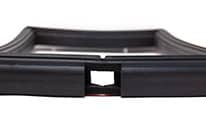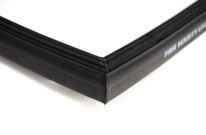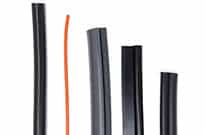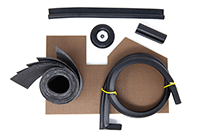
Fluorosilicone combines the temperature and environmental resistance of silicone with expanded resistance to fuels, oils, hydrocarbons, and solvents. Often, fluorosilicone rubber (FVMQ) is used in applications with both chemical exposure and temperature extremes. When fluorosilicone is compounded with metal or metal-coated particles, it can provide EMI shielding.
Elasto Proxy supplies fluorosilicone materials for distribution, but we also fabricate fluorosilicone sheets and extrusions into seals and gaskets. In addition, we offer molded fluorosilicone parts. Keep reading to learn about fluorosilicone’s advantages, disadvantages, compatibility, applications, specifications, and design considerations.
If you’re ready to request a quote, please contact us.
Fluorosilicone Strengths
Fluorosilicone costs more than some other elastomers, but it offers these advantages.
- Strong chemical resistance: Unlike silicone, fluorosilicone won’t swell, degrade, or soften from hydrocarbon-based fuels, petroleum oils, mineral oils, and common solvents.
- Wide operating range and thermal stability: Standard grades of FVMQ rubber maintain their properties across temperatures from around -65°C (-85°F) to 200°C (392°F).
- Environmental resistance: Fluorosilicone resists ultraviolet (UV) light from the sun, ozone in the air, weathering, and moisture.
- Flame resistance: FVMQ rubber resists ignition and will self-extinguish; however, it can char or degrade.
- Flexibility and resilience: Unlike Viton® (FKM), a high-performance material with similar properties, fluorosilicone remains flexible and resists compression set.
Fluorosilicone Weaknesses
Despite its advantages, fluorosilicone rubber comes with some tradeoffs.
- Lacks mechanical robustness: Compared to general-purpose rubbers, fluorosilicone has lower tear strength and less resistance to abrasion, friction, and wear.
- Limited chemical resistance: Fluorosilicone does not resist all chemicals. Some hydraulic fluids may cause swelling or hardening. Strong acids cause rapid degradation.
- Gas Permeation: FVMQ is susceptible to gas permeation, which can limit its utility in vacuum systems and high-pressure gas sealing applications.
- Higher cost: Fluorosilicone generally costs less than Viton® (FKM), but FVMQ is more expensive than silicone and significantly more expensive than rubbers like EPDM.
- Limited resistance to water and steam: FVMQ is not suitable for hot water or steam. Fresh water and salt water can cause swelling.

Fluorosilicone Compatibility
The table below summarizes fluorosilicone’s compatibility with some common chemicals and environmental conditions.
- Excellent: Minimal or no effect
- Good: Minor effect; suitable for most applications
- Fair: Noticeable effect; limited use
- Poor: Not recommended
Substance/Condition | Compatibility | Notes |
Fuels (gasoline, diesel, jet) | Excellent | Superior resistance |
Oils (mineral, lubricating) | Excellent | Minimal swelling |
Ozone / UV | Excellent | Maintains its properties over time |
Aromatic hydrocarbons (benzene, toluene) | Good | Some swelling possible |
Solvents (ketones, esters) | Good | Some attack possible |
Flame / Heat | Good | Inherently flame resistant |
Water (fresh/salt) | Fair | Prolonged exposure can cause swelling |
Acids (mild, dilute) | Fair | Performs adequately with weak acids |
Alkalis (mild) | Fair | Avoid concentrated bases |
Strong acids (HCl, H₂SO₄) | Poor | Rapid degradation |

Fluorosilicone Applications
With its fuel resistance, temperature stability, and sealing performance, fluorosilicone is used in these and other industries.
- Aerospace and defense: fuel seals and tank seals
- Automotive: turbocharger seals, fuel hoses, and fuel/emissions control systems
- Chemical processing: seals for pumps, compressors, and instrumentation
- Mechanical assemblies: industrial seals that resist synthetic diester oils
Fluorosilicone Specifications
Because fluorosilicone rubber is used in critical applications, engineers may need to specify materials that meet specifications from standards organizations or the U.S. military.
- ASMR25988 (formerly MIL-DTL-25988) covers fluorosilicone sheets, strips, extrusions, O-rings, and molded parts for aerospace and defense applications. This spec is divided into Types, Classes, and Grades. It includes both general-purpose and higher-strength materials.
- SAE AMS 3331D, SAE AMS 3329D, and SAE AMS 3328D cover fluorosilicones for fuel systems, engines, and lubricating oils, typically in industrial applications. SAE International maintains these standards.
- AMS 3325, AMS 3326, AMS 3327, AMS 3328, AMS 3329, AMS 3330 and AMS 3301 fluorosilicones meet Aerospace Material Specification (AMS) that are required for some aerospace and defense applications.
- MIL-DTL-83528 applies to fluorosilicones that are filled with metal or metal-coated particles for EMI shielding.
Elasto Proxy sources EMI fluorosilicones and converts sheet materials into finished gaskets.
Fluorosilcone Design Considerations
Engineers who specify fluorosilicones need to follow some best practices for sealing success.
- Use the right standard: For example, AMSR25988 has superseded MIL-DTL-25988, and MIL-DTL-83528 only applies to fluorosilicones (and silicones) used in EMI gaskets.
- Ask about testing and traceability: Ask for a batch-level of Certificate of Analysis (COA) to ensure that the material you receive meets a specification’s full requirements.
- Verify compatibility: Even with a spec-grade material, confirm its compatibility with the fuel, oil, solvent, or chemical in your application under the expected service conditions.
- Choose the right durometer: Softer compounds are more flexible and provide better low-temperature sealing. Harder compounds are stiffer but have greater load-bearing capacity.
- Use it for static sealing: Because fluorosilicone has limited resistance to abrasion, tearing, and wear, it’s best for seals where there’s little to no movement.
Ask Elasto Proxy for Fluorosilicone Materials and Products
When specifying fluorosilicone for a project, it’s not enough to simply ask for “fluorosilcone rubber” or even “FVMQ”. As this article explains, there are both standard and spec-grade materials. Moreover, different specs apply to different industries and applications. Even if you don’t need to meet a particular specification, fluorosilicone costs enough to select it with care.
Elasto Proxy can help you with material selection. Plus, we can supply you with fluorosilicone in lower minimum order quantities (MOQ) than you might find elsewhere. We’re not just a distributor, however. At our branches near Montreal, Canada and in Simpsonville, South Carolina (USA), Elasto Proxy uses water jet cutting to produce parts like seals and gaskets with speed and accuracy.
Do you need fluorosilcone rubber for prototypes or low-to-medium volumes? We’re ready to help.