Custom Inflatable Seals from Elasto Proxy
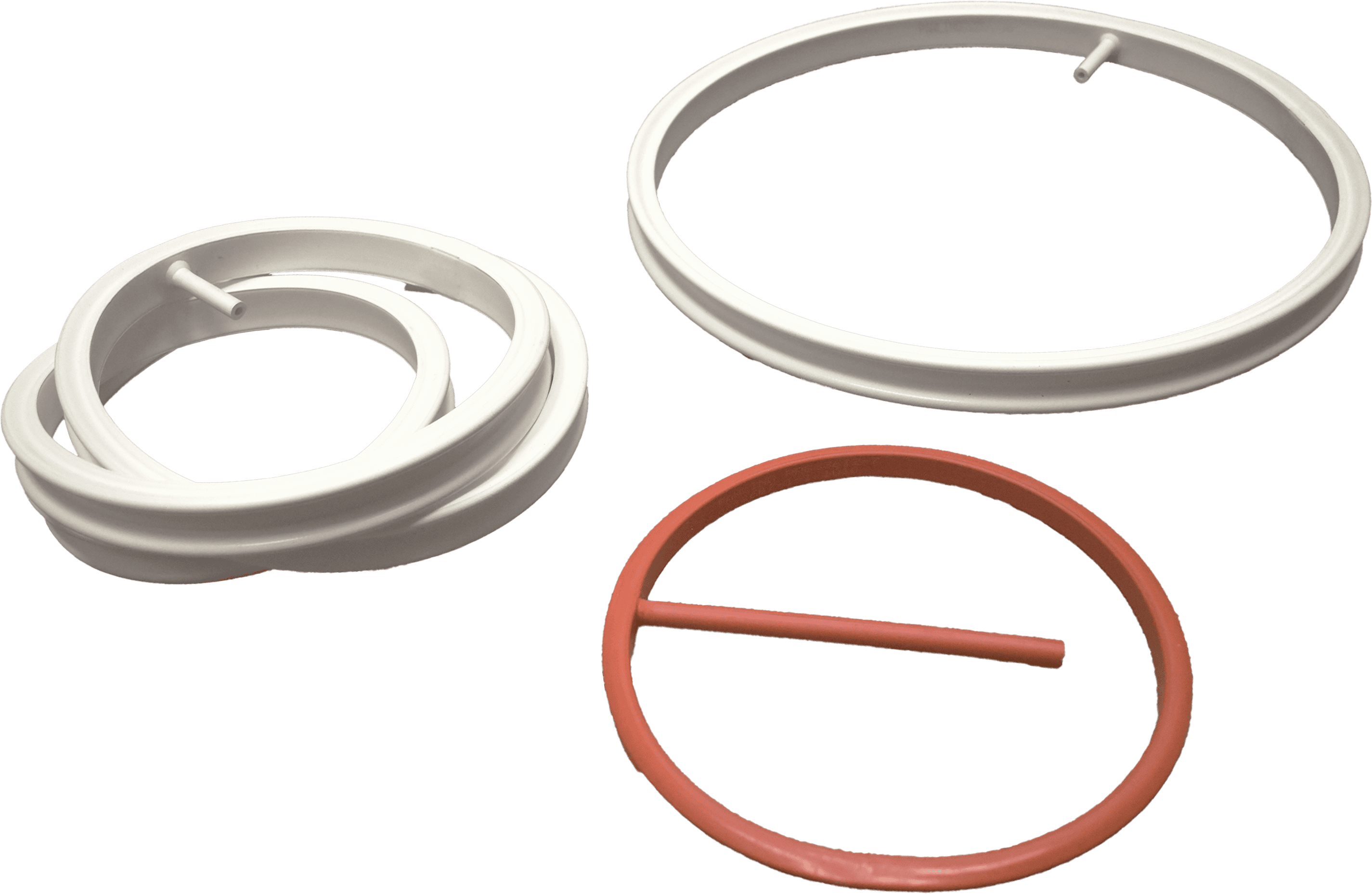
Inflatable seals are rubber gaskets that inflate instead of compress to seal-out the environment. They conform well to irregular or misaligned surfaces and require low closure force. Typically, inflatable seals are filled with air; however, some products use gases, liquids, or gels instead. The medium is delivered through a hose and then pressurized so that the inflatable seal expands. Depending on the specific seal type, clamps may be needed to hold the gasket in the channel.
Because they apply their own sealing pressure, pnuematic seals are effective at filling gaps with unusual shapes or sizes. They can be molded or extruded from various elastomers and, in the case of molded seals, reinforced with fabric for added strength. Elasto Proxy can supply the inflatable seals that you need along with many other industrial rubber products, including elastomeric compressive seals, molded plastic parts, and thermal and acoustic insulation.
Inflatable Seals in Five Steps
Follow these five steps to determine what you need.
Step 1: MTAP
For any type of rubber seal, it’s important to begin with MTAP, Elasto Proxy’s easy-to-remember acronym for Media (M), Temperature (T), Application (A), and Pressure (P). The table below contains some key questions that you’ll need to ask and answer.
Media | Are any chemicals involved? Is contact with this media intermittent, or does it involve full immersion? |
Temperature | What are the minimum and maximum operating temperatures? Are there rapid changes in temperature? |
Application | What is the industry in which the inflatable seal will be used? What will the seal be installed within the application? |
Pressure | What are the pressures that seal must withstand? Will the seal be subjected to high pressure or vacuum conditions? |
Because inflatable seals are used in many different applications, it’s important to consider the entire environment. For example, inflatable seals can be used with the doors on food processing equipment, commercial laundry machinery, flood protection systems, and airplanes. Some of these environment involve exposure to greases and chemicals, while other involve demanding temperature and pressure conditions.
Step 2: Configuration
The configuration of an inflatable seal refers to the seal’s basic shape and determines the diameter you’ll need to specify. There are four basic configurations.
- circular
- rectangular
- U-shaped
- straight
With the exception of straight profiles, inflatable seals can expand outward, inward, or radially. The direction of expansion determines whether you need to specify the inner diameter (ID), outer diameter (OD), or center line (CL) diameter during seal selection. If the corner radii are tight, you may need an inflatable seal with molded or pre-formed corners.
Step 3: Profile
The seal’s profile describes its cross-section along with other important characteristics, such as fastening. Numbered types provide a standard way to identify inflatable seals by profile. The table below explains.
Type | Description |
1 | Footed seal that fastens in place and has a good range of travel. |
2 | Racetrack seal that’s held in place by friction. Used in tight spaces. |
3 | Snap-in seal with a large travel for its width, which allows it to seal large gaps. |
4 | Inflatable seal that sits in a channel and inflates outward to fill a large gap. |
7 | Mounts in a groove and is designed for heavy-duty applications. |
10 | Heavy-duty profile for high pressures and smaller gaps. |
22 | Molded bladders for small-diameter sealing. |
Step 4: Material
Inflatable seals come in compounds such as butyl, chloroprene, EPDM, natural rubber, nitrile, silicone, and polyurethane. Each compound has advantages and limitations. For example, butyl is excellent for sealing because it has low permeability to liquids and gases; however, this type of rubber has poor resistance to hydrocarbon solvents and oil.
Yet, compound alone isn’t the only material consideration. If you need a seal with added strength, you can choose nylon or Kevlar for reinforcement. For mass transit applications such as buses and rail, you may need a seal material with low smoke and flame resistance. There are also inflatable seals for medical and pharmaceutical applications that meet USP Class VI requirements for cleanliness.
Step 5: Air Connectors
Inflatable seals use four main types of air connectors:
- flexible hose connectors
- solid shank end connectors
- mechanical connectors
- molded-in-place connectors
Typically, the location of the seal determines the connector type. Most hoses are made of polyurethane, and additional specifications include hose length, color, fittings, and whether the hose is supplied loose.
Inflatable Seal Applications
There are four main inflatable seal applications.
- Powder processing
- Agriculture
- Food and beverage manufacturing
- Research and development (R&D)
Elasto Proxy serves all these industries – and more.

Powder Processing
Powder processors uses custom inflatable seals to provide airtight, dust-tight, and contamination-free sealing with very fine or potentially hazardous materials, especially metal and ceramic powders.
Isolation Gloveboxes and Containment Systems
Isolation gloveboxes and containment systems need to provide airtight sealing between glovebox panels, doors, or ports. A custom inflatable seal that maintains an inert atmosphere with argon or nitrogen gas helps prevent oxidation or contamination.
Rotary Valves and Feeders
Industrial powders are fed from hoppers into processing equipment. A custom inflatable seal can help maintain pressure differentials while supporting easy cleaning and access. During the powder transfer process, an inflatable seal can prevent leakage or backflow.
Mixers and Blenders
Powder mixing and blending needs to produce a homogenous mixture of powders and additives. Custom inflatable seals ensure dust-tight conditions and prevent the loss of material during high-speed mixing.
Kilns and Furnaces
The doors and ports for kilns and furnaces need seals that can also withstand high-temperatures. A custom inflatable seal can protect against heat loss while maintaining the atmospheric purity that’s required sintering and other processes.
Bulk Bag Handling and Transfer Systems
To ensure environmental health and safety, proper sealing is essential during powder handling, weighting, or transfers. Inflatable gaskets can form tight, conformable seals around soft or irregular surfaces such as drums or bulk bag spouts.

Agriculture
In agricultural equipment, custom inflatable seals are with seed planters and combines for dust-tight sealing, contamination control, and efficient material handling. Often, agricultural environments are characterized by fine particulate matter such as seed dust, chaff, and fertilizer.
Seed Hoppers and Bin Access Doors
A custom inflatable gasket can provide an airtight seal around a hopper lid or access panel. This keeps out moisture, which can ruin seeds, and prevents the escape of seed dust, which can pose a health risk.
Planter Row Units
The rubber seals that are used in vacuum or pneumatic seed delivery systems need to maintain air pressure for accurate placement and minimal leakage. A custom inflatable seal can meet these requirements while conforming to movable joints.
Articulated or Folding Sections of Equipment
Some agricultural equipment contains folding booms or movable frames. A custom inflatable seal can bridge the gaps between non-stationary components while keeping out dust, debris, and moisture.
Chemical Fertilizer Compartments
In seed planting equipment, it’s important to isolate the compartment where dry or liquid fertilizer is stored. A custom inflatable seal can help prevent cross-contamination with other dispensable materials while supporting easy access for cleaning.
HVAC Ducts and Doors
The HVAC doors and ducts on farm equipment needs to ensure that heating, ventilation, and air conditioning systems remain pressurized. A custom inflatable seal can meet this requirement while keeping out dust during spraying or seeding.

Food and Beverage Manufacturing
In the food and beverage manufacturing industry, custom inflatable seals are used to maintain hygiene, control allergens, and ensure product integrity. Beverage manufacturers can also use a custom inflatable seal for applications such as sealing a metal wine cask.
Bag Clamping and Filling Stations
During bag filling operations, inflatable seals are used at bag necks or fill nozzles. With flour, for example, these seals can conform to different bag sizes to prevent material loss and the escape of dust that may contaminate production environments.
Bulk Bag Fill and Discharge Systems
A bulk bag fill and discharge (FIBC) system needs to ensure the dust-free, hygienic transfer of dry ingredients without manual intervention. Because it provides airtight sealing, a custom inflatable gasket is a good choice for gripping and sealing around bag spouts during filling or emptying.
Hopper and Chute Access Doors
Inflatable gaskets are also used around inspection doors and the maintenance panels on hoppers and conveyors. They ensure a sanitary, leak-proof closure that is also easy to disengage for cleaning and maintenance.
Rotary Valves, Sifters, and Blenders
Rotating or vibrating components in food and beverage manufacturing need to maintain airtight connections. A custom inflatable seal can help prevent leakage, contamination, and pressure loss in systems that handle fine powders.
Packaging Machines and Form-Fill-Seal Units
Food and beverage manufacturers want to quickly engage and disengage seals during automated or high-speed operations. A custom inflatable seal can provide controlled and reliable sealing in areas where pouches or bags are formed or filled.

Research and Development (R&D)
Finally, custom inflatable seals are used in a wide variety of R&D applications that require precision sealing, environmental control, and modular test setups. Examples include:
- Aerospace and Defense Prototyping: Environmental test chambers use inflatable seals for vacuum, altitude or thermal testing. Wind tunnels also used pneumatic seals.
- Automotive R&D: Engine and component test stands use inflatable seals for secure but temporary connections between test articles and air, fluid, or exhaust systems.
- Pharmaceutical and Biotech: Inflatable seals help maintain cleanliness around isolators, clean room pass-throughs, and containment chambers.
- Semiconductors and Electronics: R&D processes for silicon wafers, batteries, and sensitive electronic components use inflatable sealing for clean, dry, and inert environments.
- Robotics and Automation Testing: A custom inflatable seal can be used to test variable grippers or to build adaptive sealing surfaces in robotic tooling, especially for soft robotics.
- Medical Device Testing: Custom text fixtures require sealing around tubing, valves, or components during simulated-use testing, pressure tests, and fluid delivery tests.
- Nuclear or Hazardous Material Testing: Inflatable seals can help contain radioactive or toxic materials during experiments in gloveboxes, hot cells, or shielding enclosures.

Inflatable Seal Q&A
This custom inflatable seals Q&A from Elasto Proxy explains what you need to know about a category of products that provide airtight and liquid-tight sealing for demanding applications.
What are inflatable seals?
Inflatable seals are flexible, hollow profiles that are filled, or inflated, to form an environmental seal. They are typically filled with air but are sometimes filled with nitrogen or other inert gases instead. The medium is delivered through a hose and then pressurized so that the seal expands.
What are they made of?
Inflatable seals are made of rubber compounds such as EPDM, which is good for outdoor use, or silicone, which can withstand higher temperatures. Butyl, nitrile, and other compounds are used as well. Viton is sometimes used for its enhanced resistance to chemicals and higher temperatures.
How do they provide airtight and liquid-tight sealing?
Inflatable seals are made of elastomers that are airtight and water-resistant. When inflated, the seal expands to press against the mating surface with a uniform and controlled force. This ensures that there aren’t any gaps where air or liquid could enter or escape.
Can they meet regulatory requirements or industry standards?
Yes. Inflatable seals can meet FDA requirements and USP Class VI standards – just to name a few.
How do they attach?
Inflatable seals can fit into a groove or use mechanical retainers such as clamps. They can also support the use of adhesives. For the best results, choose an attachment method that’s compatible with your larger product design.
How are inflatable seals different from other types of gaskets?
Most rubber gaskets rely upon compression rather than inflation. In other words, the gasket is compressed to fill a gap. Inflatable seals also fill gaps and provide sealing, but they are filled-up rather than pressed-down.
What are some advantages of inflatable seals?
Inflatable seals conform well to irregular surfaces, require low closure force, and provide dynamic sealing. This makes them a good choice for applications where surfaces are misaligned, there isn’t enough compressive fore, or there is relative movement between surfaces (e.g., a shaft and housing).
What are some key product specifications?
Seal profile is key because geometry affects how the seal inflates and contacts the mating surface. Inflation pressure is important because the pressure range must be matched to the seal’s design to prevent over-inflation or under-inflation. Inflation and deflation speed are worth considering as well.
What are some examples of custom inflatable seals?
Custom inflatable seals can inflate into a circle, square, rectangle, or straight line. They can also expand outward, inward, or radially. Products are available in specific shapes (profiles), sizes, colors, and compounds.
Can they handle high pressures?
Yes. Custom inflatable seals work well under low closure force, but they can also handle higher pressures. Often, Aramid reinforcements are used for these applications. Aramid fiber is a strong, lightweight, and heat-resistant fiber with an exceptional strength-to-weight ratio.
How are inflatable seals manufactured?
Inflatable seals can be molded, but they’re typically extruded instead. During the extrusion process, a rubber compound is forced through a metal tool called a die. The die’s shape determines the cross-section of the inflatable seal. Extrusion produces a length or coil that is ready for fabrication.
How are custom inflatable seals fabricated?
Elasto Proxy uses water jet cutting to convert coils into the lengths you need. For example, a 100-ft. (30.48 m) coil can be cut into 10 lengths that are each 10-ft. (3.048 m). The end joints are then bonded, typically with vulcanization but sometimes with cold bonding instead.
What is the minimum order quantity?
There isn’t one! Elasto Proxy welcomes small projects. This is part of what makes us different from other inflatable seal suppliers. We also differ in that we make inflatable seals for customer-specific projects and inspect what we fabricate for quality.
What are some applications for custom inflatable seals?
Custom inflatable seals are typically used in powder processing, agricultural, food and beverage manufacturing, and research and development applications. They’re also used in cleanrooms to maintain pressure differentials and with autoclaves or other pressure vessels.
Inflatable Seal Product Gallery