Rubber materials squeeze or flatten when an external force is applied. This compression isn’t inherently problematic, however. In fact, compression is essential for sealing because the rubber fills the gaps between mating surfaces, including small discontinuities. The real problem is permanent compression, a phenomenon known as compression set.
When rubber fails to recover its original thickness after being compressed, its ability to seal will fail. That’s why understanding compression set is critical if you’re an engineer who’s comparing rubber materials. This article from Elasto Proxy examines compression set, explains why it matters, explores the factors that affect it, and includes some practical examples.
Keep reading to learn more and contact Elasto Proxy for industrial sealing solutions. We’re a rubber fabricator and distributor that provides value-added services like design reviews and help with material selection.
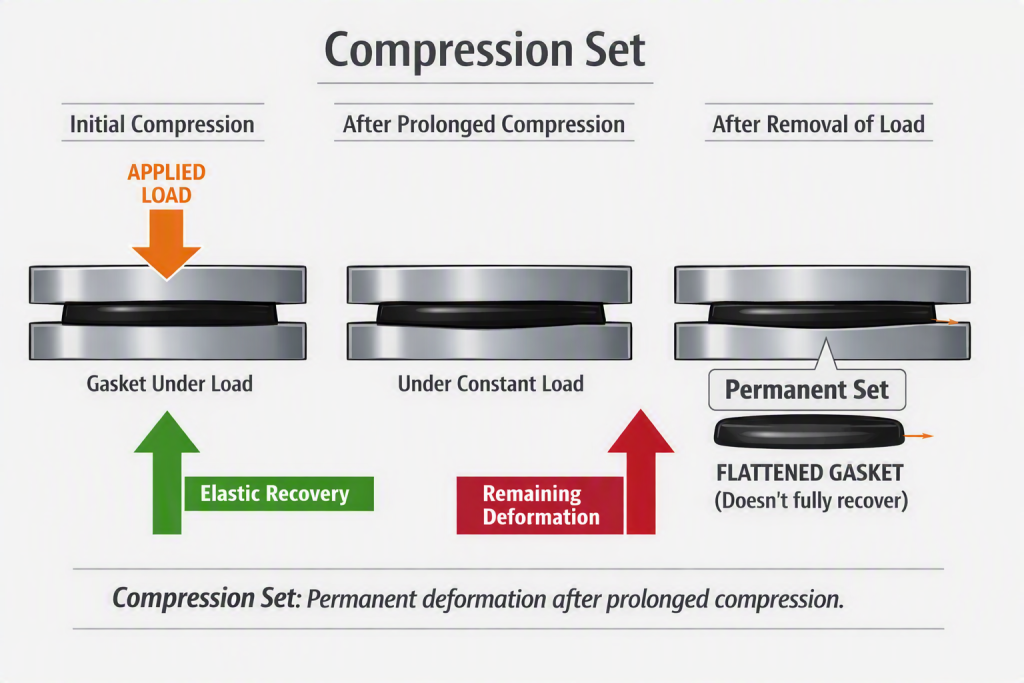
What Is Compression Set?
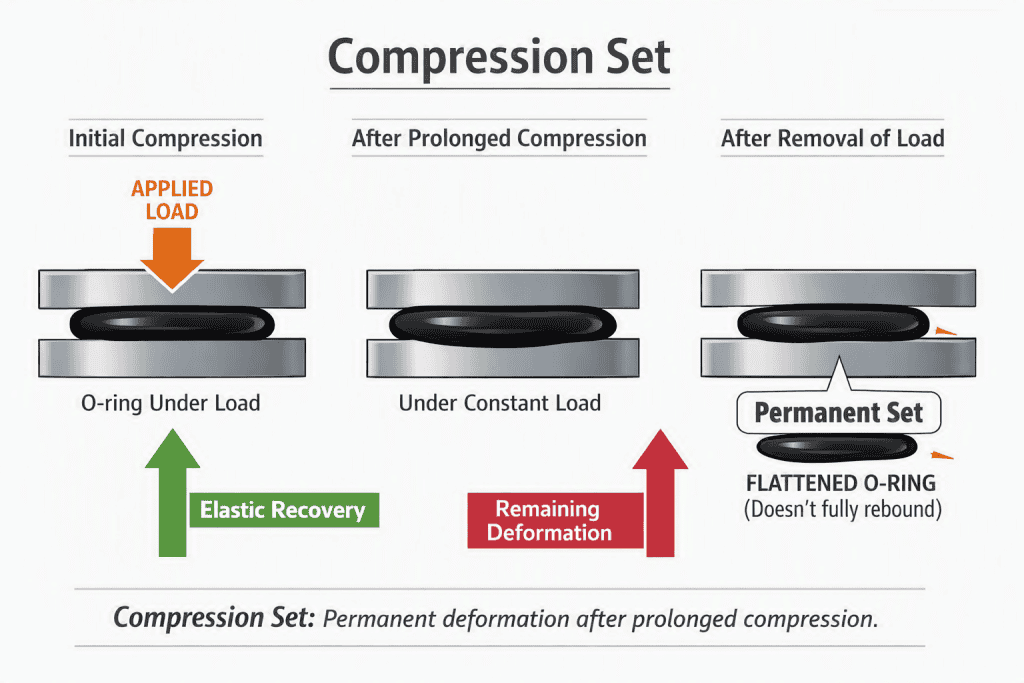
Compression set is the permanent deformation that remains in a rubber material after it’s been compressed for a specified time under controlled conditions. It’s typically expressed as a percentage of the original thickness.
For engineers, compression set is defined as:
Compression Set (%) = t0 – tr / t0 x 100
Where:
- t0 = original thickness
- tr = thickness after recovery period
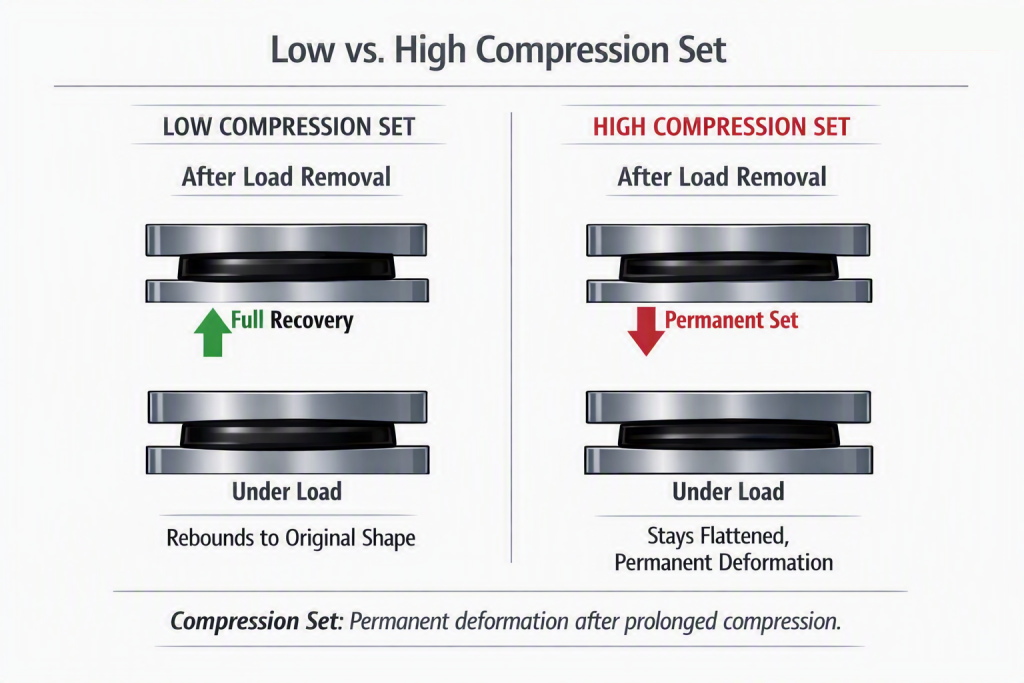
What does this mean when a gasket fabricator talks about low or high compression set?
- Low compression set means the rubber returns close to its original thickness.
- High compression set means the rubber stays permanently compressed.
Sometimes, the phrase “good compression set” is used instead of “low compression set”, but the meaning is the same.
Why Does Compression Set Matter?
Rubber parts depend on elastic recovery – a material’s ability to return to its original shape after a load (typically compression) is removed.
- Gaskets must rebound to maintain sealing pressure.
- O‑rings must recover to fill gaps and maintain contact stress.
- Vibration mounts must return to their original height to isolate vibrations.
- Pads and cushions must rebound to avoid bottoming out.
If a material takes a high compression set, it may lose its ability to perform these functions.
All Rubber Compresses, But Permanent Compression Set is a Problem
Rubber is used for sealing, energy absorption, and vibration isolation because (unlike metal) it readily compresses under load. Practically speaking, compression allows:
- Gaskets and O-rings to conform to surface irregularities
- Vibration mounts to deflect under load
- Pads and cushions to absorb energy.
What’s the problem with the compression then? If a rubber doesn’t recover after a load is removed, this permanent compression leads to problems like these:
- Loss of sealing force causes leaks
- Reduced vibration isolation causes increased noise and wear
- Loss of dimensional stability causes misalignment
- Premature failure causes downtime
Consider these examples.
- A gasket might not seal after the bolts are tightened, which causes leaks.
- A vibration mount may sag, which changes the alignment of machinery.
This is why compression set is a measure of long‑term reliability instead of just initial performance.
How Compression Set Is Measured
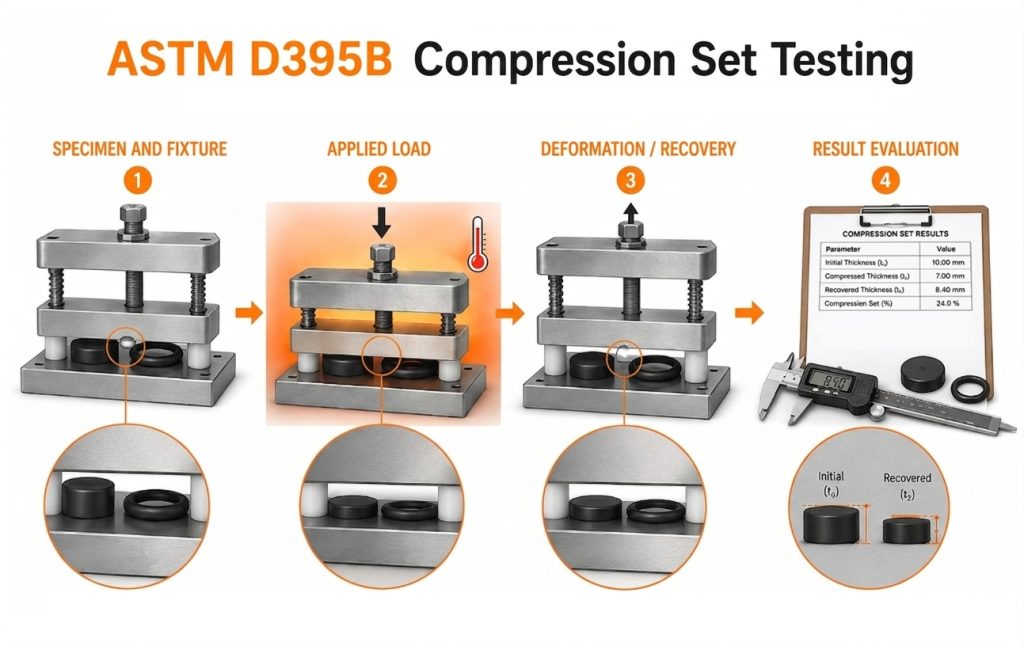
Compression set is typically measured using ASTM D395 Method B. The test involves:
- Compressing a rubber specimen to a defined percentage (usually 25%).
- Holding it at a controlled temperature for a specified time (often 22–70 hours).
- Releasing the load and allowing recovery for 30 minutes.
- Measuring the remaining deformation.
This standardized method allows engineers to compare different materials consistently.
Factors That Affect Compression Set
Compression set is affected by temperature, material type, and the duration and amount of compression.
Temperature
High temperatures and low temperatures can both effect compression set.
- High temperatures increase compression set. As temperature rises, rubber loses its ability to rebound.
- Low temperatures cause rubber to stiffen, which makes recovery slower or incomplete. Some elastomers remain more flexible in the cold, however.
Material Type
Different rubber materials have different compression set characteristics. For example:
- Silicone has excellent compression set and maintains its elasticity across a wide temperature range, including higher heat than other common elastomers can withstand
- EPDM has good compression set and is commonly used in applications where there’s water, weather, or sunlight.
- Nitrile (NBR) has moderate compression set. It’s oil-resistant, but not ideal for high-temperature or static sealing under long-term compression.
- Neoprene has moderate to high compression set. It’s a good general-purpose rubber but not recommended for critical sealing applications.
- Polyurethane has high compression set under static loads. It’s abrasion resistant and best for dynamic sealing.
Remember most rubber materials contain many ingredients. Sometimes, these compounds contain fillers and plasticizers than influence compression set.
- Fillers: Compounds with greater amounts of fillers are stiffer. Since they might not bounce back, have a high risk of permanent compression set.
- Plasticizers: Compounds with plasticizers are softer and more flexible. Yet this softness can increase the risk of permanent compression set over time.
Duration and Amount of Compression
The duration and amount of compression are also key factors.
- Longer compression times increase compression set. For example, a window gasket that’s compressed for 5 years will take a greater set than one that’s compressed for 5 hours.
- Higher compression percentages (e.g., 40–50%) increase compression set. For example, a door gasket compressed to half its original size may not bounce back.
Practical Examples Using Common Rubber Materials
Compression set is an important consideration during material selection, but so are material properties like high-temperature resistance, oil contact, exposure to weather, and static mounting under heavy loads. Consider the following examples.
High‑Temperature Gasket in an Industrial Oven
- Silicone is ideal because it has low compression set at 200°C.
- EPDM c would take significant compression set.
- Nitrile and neoprene would fail quickly.
Oil‑Contact Seal in a Hydraulic System
- Nitrile is preferred for its oil resistance.
- Silicone would swell and fail.,
- Nitrile’s compression set is acceptable because temperatures are moderate.
Outdoor Weather Seal
- EPDM is ideal because its weather-resistant and has good compression set
- Neoprene is acceptable but less durable.
- Silicone is excellent but more expensive.
Static Mount Under Heavy Load
- Polyurethane may take high compression set and sag over time.
- EPDM or nitrile may perform better depending on temperature.
Choose Value-Added Gasket Fabrication
Compression set is one of the most important properties of rubber materials, especially for sealing, vibration isolation, and long-term dimensional stability. While all rubber compresses, permanent compression is the real problem because it can lead to leaks, sagging, loss of vibration isolation, and premature seal failure.
Elasto Proxy can help you to select the rubber material based on its compression set, and we also offer design reviews. If you’re engineering rubber parts and want to ensure your design accounts for this critical parameter, we can help.