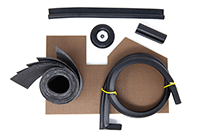
Does your application require static sealing or dynamic sealing? The answer to that question drives downstream choices ranging from material type and durometer to compression percentage, gasket style, and installation method. It also affects expected service life – the length of time a seal can meet performance requirements under real-world operating conditions.
Static seals and dynamic seals may look similar, but they behave very differently when in use. A gasket that’s designed for a stationary flange can fail rapidly when exposed to motion, friction, or repeated compression cycles. Conversely, a dynamic seal that’s made for movement may leak if it’s installed in a static joint with insufficient preload (i.e., initial compression).
This article from Elasto Proxy examines each sealing mode. Engineers who use this information can avoid premature failures and reduce maintenance costs. They can also specify rubber gaskets that perform as intended under expected operating conditions. Keep reading to learn more and contact Elasto Proxy if you need a gasket fabricator who adds more value.
What is Static Sealing?
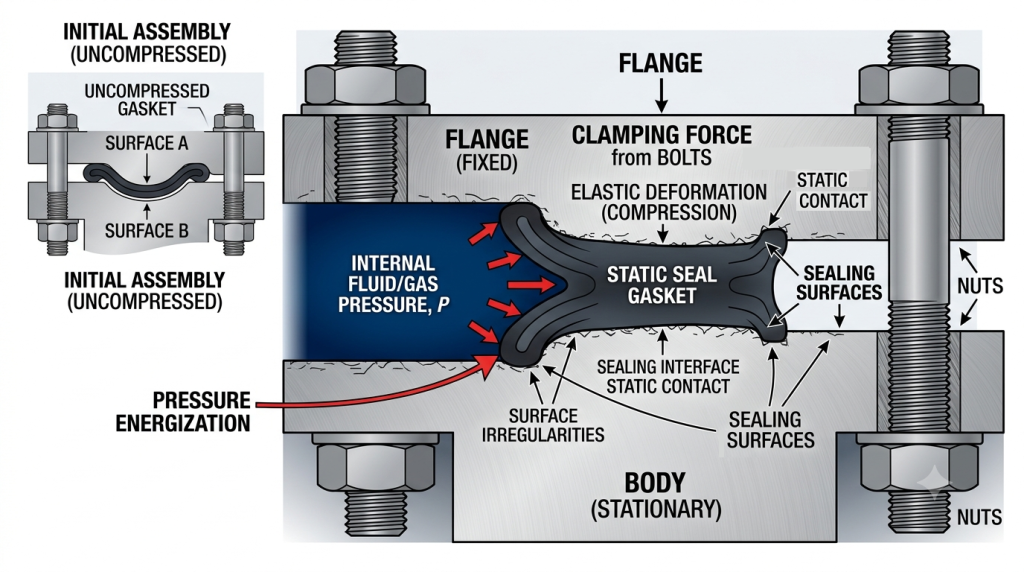
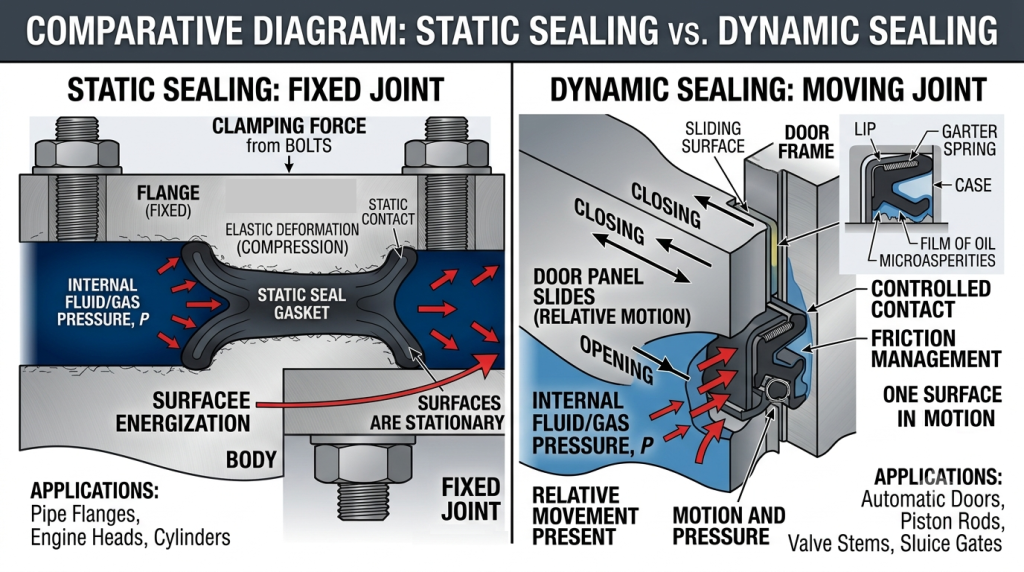
A static seal is installed between two surfaces that do not move relative to each other during normal operation. When the gasket is compressed, it stays in place and maintains sealing force through elastic deformation and pressure energization.
- Elastic deformation is the temporary shape change a gasket undergoes when compressed. This allows the gasket to fill surface irregularities (i.e., small gaps) and create a seal.
- Pressure energization is the added sealing force that’s created when internal system pressure pushes the gasket more firmly against the two sealing surfaces.
Surfaces that do not move relative to each other and that use static seals include:
- Flanges and covers
- Enclosure doors that remain closed for long periods
- Pressure vessel lids
- Sensor housings and electronics enclosures
- Pipe connections and manifold interfaces
Remember that static seals rely primarily on initial compression and material conformability. The gasket fills microscopic surface irregularities and maintains contact stress as the system pressurizes. Because there’s no sliding or rotating motion, static seals experience fewer wear, friction, and lubrication challenges. There are some key design considerations, however.
Design Considerations for Static Seals
Consider the following when designing static seals.:
- Compression and Contact Stress: Static gaskets need to generate enough initial sealing force to prevent leakage across the entire flange face.
- Conformability and Surface Finish: Softer materials or foams can accommodate low bolt loads and uneven surfaces with poor surface finishes.
- Environmental Resistance: UV, ozone, temperature cycling, and chemical exposure are generally greater concerns than abrasion resistance.
- Compression Set: It’s still important, but compression set is less critical than in dynamic applications because a static seal is not repeatedly compressed.
Static Sealing Materials
Here are some examples of commonly used materials for static seals:
- EPDM for outdoor weather sealing
- Silicone for high/low temperature stability
- Neoprene for general industrial use
- Foam or sponge rubber for low-closure-force applications
Elasto Proxy fabricates static seals and can review your designs and help you with material selection.
What Is Dynamic Sealing?
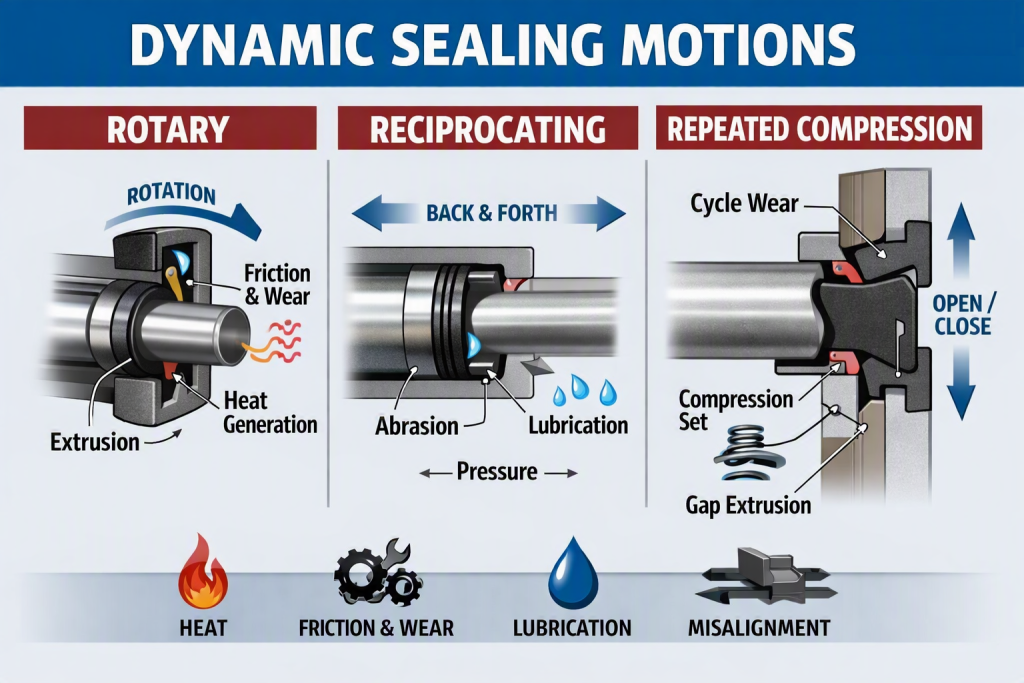
A dynamic seal must maintain sealing integrity while accommodating continuous or intermittent motion between two surfaces. There are three types of motion:
- Rotary: Pump shafts, motors, and gearboxes
- Reciprocating: Hydraulic cylinders and actuators
- Repeated compression cycles: Doors, access panels, equipment enclosures
Remember that dynamic seals are not just leak barriers. They’re also wear-interfaces that must manage friction, abrasion, heat generation, lubrication, alignment/runout, and the extrusion that occurs when a gasket is pushed into a clearance gap by pressure or notion.
Examples of dynamic seals include:
- Shaft seals on pumps and compressors
- Rod and piston seals in hydraulic systems
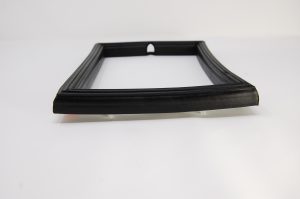
- Door gaskets that open and close frequently
- Window channels that guide sliding glass panels
- Access panel gaskets in industrial equipment
Design Considerations for Dynamic Seals
Consider the following when designing dynamic seals:
- Wear Resistance and Tear Strength: Gasket materials must withstand repeated contact cycles and resist abrasion.
- Lubrication Control: Dynamic seals must balance leakage and wear. Boundary lubrication increases wear. Full-fluid lubrication can cause leakage. Hybrid lubrication is ideal.
- Extrusion and Runout Control: Dynamic seals must tolerate misalignments, pressure spikes, and clearance gaps.
- Compression Set Resistance: Gasket materials must rebound reliably since dynamic seals are repeatedly subjected to compressive stresses and relaxation.
- Friction and Heat Management: Friction generates heat, which accelerates compression set and chemical degradation. Rotary seals may need rubber with a low coefficient of friction.
The coefficient of friction is a number that describes how much resistance two surfaces create when they slide against each other. It’s the ratio between the force needed to move one surface over another and the force pressing them together.
Dynamic Sealing Materials
Here are some examples of commonly used materials for dynamic seals:
- Nitrile (NBR) for oil resistance and general dynamic sealing
- Fluorocarbon (FKM) for high-temperature rotary applications
- Silicone for repeated compression cycles in enclosures
- Thermoplastic elastomers (TPE) or polyvinyl chloride (PVC) for sliding window channels
Elasto Proxy fabricates dynamic seals such as door gaskets and window channels. We can also review your seal designs and help you with material selection.
Key Differences Between Static and Dynamic Sealing
Static and dynamic sealing differ in terms of sealing mechanism, material selection, compression percentages, and failure modes. Here’s what engineers need to consider.
Sealing Mechanism
- Static: The sealing force comes from initial compression and pressure energization. Once the gasket is compressed, it stays in place.
- Dynamic: The sealing force must be maintained during motion. Friction, heat, and wear require gasket materials with higher tear strength and lower coefficients of friction.
Material Selection
- Static: Environmental resistance and conformability are priorities.
- Dynamic: Abrasion resistance, lubrication compatibility, and heat resistance are critical.
Compression Percentages
- Static: More compression promotes long-term sealing.
- Dynamic: Less compression reduces friction.
Failure Modes
- Static: Compression set, improper bolt loads, surface irregularities, and chemical or environmental degradation
- Dynamic: Wear and abrasion, heat buildup, lubrication breakdown, extrusion, and misalignment/runout
Best Practices for Sealing Success
Follow these best practices for sealing success.
Step 1: Classify the Joint
- Determine whether the joint is static or dynamic.
- If the joint is dynamic, determine whether the motion is rotary, reciprocating, or involves repeated compression.
Step 2: Match the Seal Type to the Application
- Static seals: Use gaskets that conform to flange surfaces and tolerate minor variations.
- Dynamic seals (rotary): Use shaft seals with optimized lip geometry and materials like FKM for high heat resistance in extreme environments.
- Dynamic seals (reciprocating): Use lip seals designed for rolling motion and low friction (i.e. diaphragm seals).
- Dynamic seals (repeated compression): Use resilient foams or silicones with excellent compression set resistance.
Step 3: Verify Conditions
If the seal is dynamic, verify the following conditions:
- Motion type and speed
- Pressure and pressure spikes
- Clearance gaps
- Temperature and media
- Alignment/runout
- Lubrication conditions
Elasto Proxy Fabricates Static and Dynamic Seals
Elasto Proxy fabricates rubber gaskets for both static and dynamic applications. We help engineers classify the type of sealing joint and select the right gasket material. Through design reviews, we can help you to optimize compression, geometry, and installation for long-term performance. We’re not just a rubber fabricator or distributor. We’re a value-added manufacturing partner.