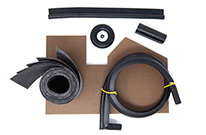
Engineers who design heavy equipment and outdoor enclosures often choose EPDM for sealing and insulation. This synthetic rubber outperforms many other elastomers in outdoor and weather-exposed environments. In addition to water, EPDM resists ultraviolet (UV) light from the sun and ozone from the air. It also withstands temperatures from -50 °C (-58 °F) up to 150 °C (302 °F).
Yet there’s more than one type of EPDM for weather-resistant seals. Depending on your application, solid EPDM or sponge EPDM could be the right choice. To determine which one to select, you’ll need to consider closure force and gap filling requirements, surface conformity, material properties, and typical applications.
Keep reading to learn more and contact Elasto Proxy for either type of material. We distribute EPDM as sheets, rolls, and coils, but Elasto Proxy also fabricates this industrial-strength rubber into custom products like ready-to-install gaskets or thermal-acoustic insulation.
Solid EPDM: Strength Meets Stability
Internally, solid EPDM has a dense, nonporous structure that’s created during vulcanization – the chemical process that turns soft, sticky raw rubber into a durable elastic material. Unlike sponge rubber, solid EPDM is not made with blowing agents – substances that produce a cellular or porous structure with air pockets.
Closure Force Requirements and Gap Filling
Because solid EPDM is more difficult to compress, it requires higher closure forces to achieve an effective seal. This stiffness is an asset in bolted flange joints or heavy-duty clamps with high mechanical torque. In applications with lighter latches or larger tolerances, however, excessive closure force can warp enclosure panels or prevent doors from closing properly.
Surface Conformity
Solid EPDM conforms best to flat, rigid, and smoothly machined surfaces. If a mating flange has warping, weld seams, or surface roughness, the solid rubber may form a “bridge” across low spots instead of flowing into them. In heavy equipment cabins or electrical and electronic enclosures, this can create potential leak paths for moisture, dust, or air.
Additional Material Properties
Solid EPDM has these material properties.
- Durometer and Rigidity: Most compounds range from 40 to 90 on the Shore A scale. A 40-durometer compound is soft like a pencil eraser, while an 90-durometer material is hard like a hockey puck.
- Abrasion and Pinch Resistance: Its dense, nonporous internal structure offers superior resistance to mechanical wear, tearing, cutting, and pinching.
- Load Bearing and Force Distribution: Solid EPDM resists permanent indentation and can distribute heavy mechanical loads without bottoming out.
- Tensile Strength: Most compounds offer tensile strengths around 1,000 PSI and elongation values near 300%. This gives them durability under tension and shear.
Typical Applications for Solid EPDM
Use solid EPDM for structural seals and high-load components where durability and mechanical stability take precedence over low-force compressibility. Examples include:
- Window channels and glazing seals for heavy-duty use
- Edge trim, bumpers, and wear strips for structural applications
- Anti-vibration pads and load-bearing isolators for use under heavy machinery
- Bolted flange gaskets for water, glycol, and low-pressure steam systems
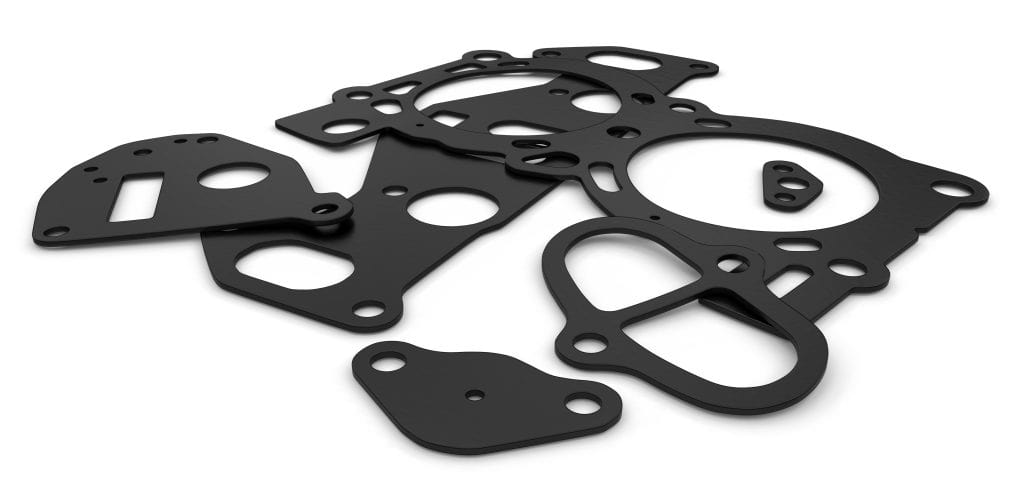
Sponge EPDM: Flexibility That Fits
Sponge EPDM is made with chemical blowing agents that expand during vulcanization and create a lightweight, cellular matrix. These cells can be open or closed.
- Open cell sponge EPDM contains interconnected pockets that allow air and fluids to pass until the rubber is significantly compressed.
- Closed cell sponge EPDM features non-interconnected, balloon-like cells that are filled with a gas to prevent the passage of air or fluids.
For environmental sealing, closed-cell sponge EPDM is typically used because it blocks water, air, and dust at low pressures.
Closure Force Requirements and Gap Filling
Because its internal cells collapse easily under pressure, closed-cell sponge EPDM seals effectively with much lower closure force. This makes it ideal for hinged doors, access panels, and lightweight enclosures where heavy latching hardware is impractical. Sponge EPDM also excels at filling large, uneven gaps.
This type of EPDM is also used when manufacturing tolerances, thermal expansion, or structural flexing cause the gap between two mating surfaces to vary along the perimeter of a joint. In these applications, sponge EPDM compresses proportionally.
Surface Conformity
With its compliant cellular structure, sponge EPDM readily conforms to irregular, textured, or contoured surfaces. In outdoor or weather-exposed environments, it wraps around minor surface imperfections, rivet heads, and sheet-metal overlaps to create a continuous environmental barrier.
Additional Material Properties
Sponge EPDM offers these material properties.
- Compression Deflection vs. Durometer: Because sponge EPDM has a low durometer, engineers typically specify it in terms of compression deflection instead. Under ASTM D1056, this is the force required to compress a sample by 25% of its original thickness.
- Vibration and Shock Absorption: The air-filled cells act as microscopic cushions that dampen mechanical vibration, reduce structural rattle, and absorb impact energy.
- Thermal and Acoustic Insulation: The trapped gas within closed cells provides low thermal conductivity and strong sound-dampening characteristics. This supports its use with cab insulation and HVAC systems.
- Closure Force Considerations: Sponge EPDM provides superior cushioning, but over-compressing it (typically beyond 50% of its original height) can rupture cell walls and cause compression set – permanent deformation that leads to seal failure.
Typical Applications for Sponge EPDM
Use closed-cell sponge EPDM with doors, hatches, and enclosures where low closure effort, tolerance compensation, and environmental protection are essential. Examples include:
- Cab door seals and compartment weather stripping on heavy equipment and commercial vehicles
- Enclosure gaskets for electrical and telecom cabinets. Engineers can choose UL 94 flame-retardant EPDM for data centers and EV charging stations.
- HVAC duct gaskets and thermal-acoustic insulation barriers
- Hatch seals, inspection covers, and lighting housings

Custom Fabrication for Solid EPDM and Sponge EPDM
Selecting the right material is important, but so is the way your parts are fabricated. Elasto Proxy offers these and other custom fabrication services.
- Water Jet Cutting: Unlike die cutting, which uses metal tools that can crush or deform sponge EPDM, water jet cutting is a tool-less process. It uses a highly-pressurized stream of water to cut cleanly through sheets or extrusions without edge distortion.
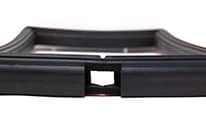
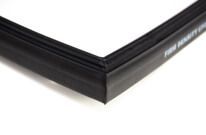
- Splicing and Bonding: EPDM extrusions can be cut-to-length or notched, but they can also be spliced or vulcanized into frame-style gaskets.
- Pressure-Sensitive Adhesive (PSA) Taping: Applying a PSA backing eliminates the need to use messy spray adhesives on your assembly line. It also ensures uniform bond strength across rough or porous substrates.
Partner with Elasto Proxy for EPDM Sealing and Insulation
Whether your design demands the structural stability of solid EPDM or the low-force conformity of closed-cell sponge EPDM, choosing the right material can prevent costly field failures. Elasto Proxy is ready to help you with material selection, and we offer design reviews that cover topics such as joint geometry, chemical compatibility, and UL 94 compliance
Are you ready to find the right EPDM for your next sealing or insulation project? Contact us for a quote or to discuss your options for distribution or fabrication.