Choosing the right durometer, a measure of hardness, is one of the most important decisions you’ll make when designing industrial rubber products. It doesn’t matter whether you’re designing a seal, gasket, thermal or acoustic insulation, or some other type of rubber part. Durometer directly affects performance.
There are consequences to making the wrong choice.
- If the rubber is too soft, it may deform, creep, or fail under load.
- If the rubber is too hard, it might not seal, absorb energy, or conform to mating surfaces.
Choosing the right hardness is critical, but that doesn’t mean durometer is well-understood. It’s easy to pick a value like 40 or 60 Shore A without fully considering the application’s mechanical, environmental, and assembly requirements.
This article from Elasto Proxy describes durometer and how it’s measured. It also explains how to select the right durometer while evaluating tradeoffs so that your rubber products perform reliably under real-world conditions.
Keep reading to learn more and contact us if you’re looking for a rubber fabricator that also offers value-added services like design reviews and help with material selection.
Understanding Durometer and Shore A Hardness
Durometer is measured using standardized test methods such as ASTM D2240, which defines how an indenter presses into the surface of a material under controlled force. For rubber, the most common scale is Shore A. Harder plastics use the Shore D scale instead.
Typical Shore A Hardness Ranges for Rubber Products
Here are some typical Shore A ranges for rubber products.
- 10–30 Shore A: Very soft, gel‑like elastomers
- 30–50 Shore A: Soft rubber for seals, cushioning, and vibration control
- 50–70 Shore A: General‑purpose industrial rubber, gaskets, and molded parts
- 70–90 Shore A: Hard rubber for structural components or high‑load environments
Why Durometer Matters in Rubber Performance
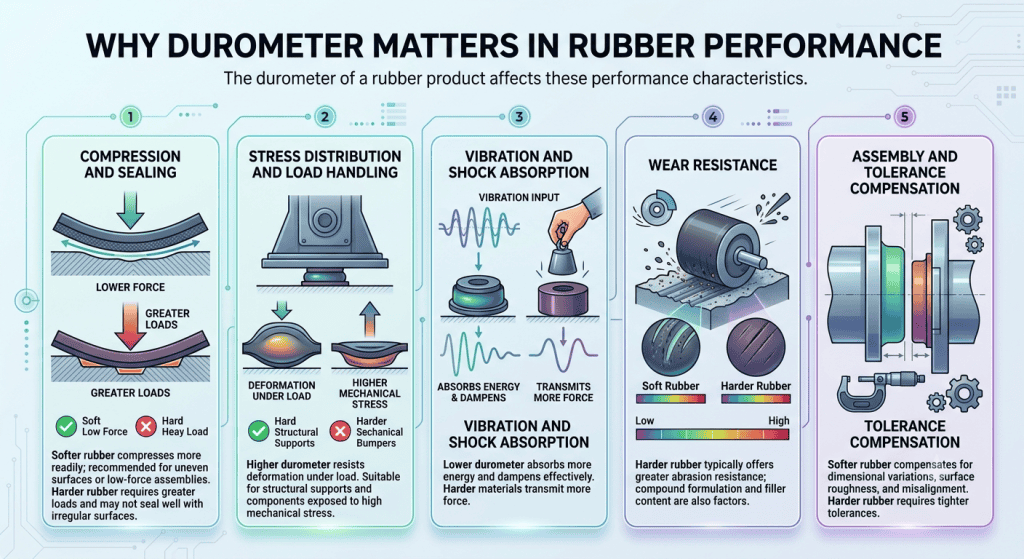
The durometer of a rubber product affects these performance characteristics.
- Compression and Sealing: Softer rubber compresses more readily and is recommended for sealing uneven surfaces or low‑force assemblies. Harder rubber requires greater loads to achieve the same compression and may not seal well if the mating surfaces are irregular.
- Stress Distribution and Load Handling: Higher durometer (harder) rubber resists deformation under load. That makes it suitable for structural supports, bumpers, and other components exposed to high mechanical stress.
- Vibration and Shock Absorption: Lower durometer (softer) rubber absorbs more energy and dampen vibrations more effectively. By contrast, harder materials transmit more force.
- Wear Resistance: Harder rubber typically offers greater abrasion resistance; however, compound formulation and filler content are also factors.
- Assembly and Tolerance Compensation: Softer rubber compensates for dimensional variations, surface roughness, and misalignment. Harder rubber requires tighter tolerances.
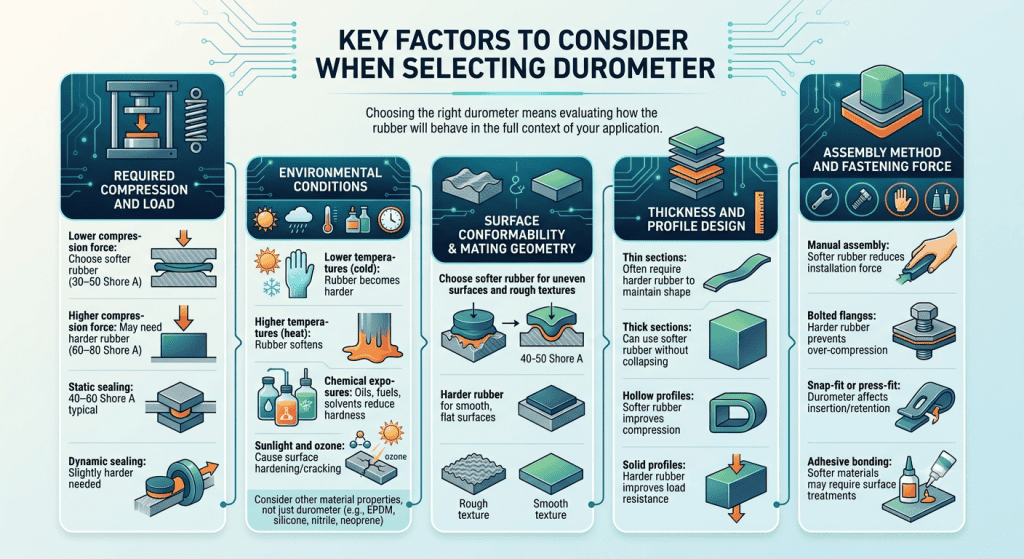
Key Factors to Consider When Selecting Durometer
Choosing the right durometer means evaluating how the rubber will behave in the full context of your application. Here’s what to consider.
Required Compression and Load
Durometer selection is usually driven by the amount of compression that a rubber product needs to achieve. Consider the amount of compressive force and whether it’s static vs. dynamic sealing.
- Lower compression force: Choose softer rubber (30–50 Shore A).
- Higher compression force: You may need harder rubber (60–80 Shore A) instead.
- Static sealing: Depending on the flange pressure, 40–60 Shore A is typical.
- Dynamic sealing: To resist extrusion, slightly harder materials may be needed.
Environmental Conditions
The hardness of rubber changes with temperature, chemical exposure, and aging.
- Lower temperatures (cold): Rubber becomes harder. Soft materials may stiffen excessively.
- Higher temperatures (heat): Rubber softens. Hard materials may lose structural integrity.
- Chemical exposure: Oils, fuels, and solvents can swell rubber and reduce hardness.
- Sunlight and ozone: They can cause surface hardening or cracking over time.
Different types of rubber materials (e.g., EPDM, silicone, nitrile, or neoprene) respond differently to environmental stressors. Consider their material properties – and not just durometer.
Surface Conformability and Mating Geometry
Choose softer rubber for uneven surfaces and rough textures. For example, enclosure gaskets with uneven flanges may need 40–50 Shore A rubber.
Thickness and Profile Design
A thin profile that’s made from soft rubber may collapse or extrude, but a thick profile made from hard rubber may not compress enough. Here are some general guidelines to consider:
- Thin sections: Often require harder rubber to maintain their shape
- Thick sections: Can use a softer rubber without collapsing
- Hollow profiles: Softer rubber improves compression behavior
- Solid profiles: Harder rubber improves load resistance
Assembly Method and Fastening Force
When specifying durometer, consider installation and assembly as well.
- Manual assembly: Use softer rubber to reduce installation force
- Bolted flanges: Use harder rubber to prevent over‑compression
- Snap‑fit or press‑fit components: Durometer affects insertion force and retention
- Adhesive bonding: Softer materials may require surface treatments to improve adhesion
Balancing Tradeoffs: Soft vs. Hard Rubber
Durometer selection is a balancing act. Here are some common tradeoffs that engineers face:
Soft Rubber (30–50 Shore A)
Advantages:
- Excellent sealing and conformability
- Strong vibration and shock absorption
- Lower assembly force
- Better tolerance compensation
Disadvantages:
- Lower load capacity
- Higher risk of creep or permanent deformation
- Potential extrusion under pressure
- May wear faster in abrasive environments
Hard Rubber (60–80 Shore A)
Advantages:
- Higher structural integrity
- Better wear resistance
- Improved extrusion resistance
- Suitable for high‑load applications
Disadvantages:
- Requires higher compression force
- Less conformability
- Reduced vibration damping
- May not seal uneven surfaces
Ask Elasto Proxy for Help with Durometer Selection
Selecting the right durometer is essential for ensuring that your rubber products perform reliably. By understanding how hardness affects compression, load handling, environmental performance, and assembly behavior, you can improve product durability and reduce failure risk.
Elasto Proxy helps engineers choose the right durometer by combining our technical knowledge and application expertise with precision fabrication. If you need help choosing the right durometer for your rubber products, choose Elasto Proxy for greater value.