Humanoid robots are advanced machines with a human-like form. They’re designed to operate in environments ranging from factories and warehouses to homes, hospitals, and stores. Most humanoid robots have a head, arms, hands, torso, and legs so that they can perform tasks that would otherwise require human dexterity or mobility. Some interact with people while others perform tasks alone or in conjunction with other robots.
As electromechanical systems, humanoid robots are equipped with motors, actuators, sensors, cameras, and controllers. Some use machine learning (ML) to improve their performance over time. Others use artificial intelligence (AI) for speech recognition and decision making. Rubber and plastic components may seem simple compared to ML and AI, but humanoid robots need these parts for protection, flexibility, sealing, insulation, shock absorption, traction, and more.
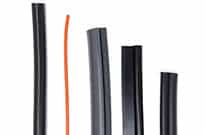
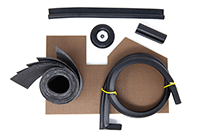
Elasto Proxy supplies rubber and plastic products to the robotics industry. Examples include fabricated components ranging from rubber gaskets and thermal insulation to molded bellows and motor mounts. Elasto Proxy is more than just a one-stop shop, however. With our value-added capabilities, we help robotics manufacturers to improve their operational efficiency with services like parts kitting and custom packaging.
Keep reading to learn about the products we supply for humanoid robots and contact us for a quote.

Protection and Flexibility
Humanoid robots that are mobile instead of stationary sometimes bump into hard surfaces. That’s why they’re equipped with rubber bumper pads on their shoulders, hips, and torsos. Rubberized knee and elbow caps, foot treads or pads, and hand grip overlays also provide protection against impacts. Typically, these parts are molded from EPDM, silicone, or thermoplastic elastomers (TPE).
Boots and bellows are flexible components that provide protection against dust, dirt, moisture, chemicals, and debris. With humanoid robots, examples include boots for knees and elbows and bellows for robotic wrists, ankles, and finger joints. Silicone, TPE, and urethane elastomers are typically used with actuators and other assemblies.
Because humanoid robots are susceptible to electromagnetic interference (EMI), they also need EMI gaskets and, in some cases, EMI O-rings. Otherwise, electronic noise from motors and power supplies may interfere with sensors, cameras, or other electronics. Humanoid robots that operate near cell phones, industrial machinery, and Wi-Fi signals are susceptible to disruptions from external sources. For EMI shielding plus environmental sealing, electrically conductive silicones are used.

Sealing and Insulation for Humanoid Robots
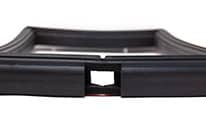
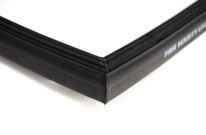
Humanoid robots use rubber seals to keep out moisture and contaminants. Examples include enclosure gaskets around torso electronics and module seals for cameras and machine vision systems. Gaskets are also used with battery compartments, microphones, and speakers. Wrist, ankle, and neck rotary joint seals may be visible, but cable or hydraulic line seals are mission-critical.
Like other types of electromechanical systems, humanoid robots produce heat and noise. Thermal insulation that’s made from polyurethane, silicone, or EVA foam is molded to fit inside legs and torsos. Molded acoustic covers are used with fans, and vibration mounts that consist of rubber-to-metal bonded assemblies can provide significant noise insulation.

Shock Absorption, Traction, and More
Molded shock absorber cores protect the hydraulic or pneumatic pistons in some humanoid robots from potentially damaging loads. In mobile robots, parts ranging from rubber soles to molded mid-sole inserts are used to provide traction. Multi-density traction pads and thermoplastic urethane (TPU) overmolds on structural feet are also incorporated into product designs.
Within humanoid robots, injection molded plastic parts are used as gearbox housings, motor mounts, sensor brackets, and battery cradle trays. They’re also used for fan and air channel shrouds, internal wire-routing channels, cable management clips, and structural brackets. Materials of construction include nylon, PEEK, acetal (POM), and various glass-filled polymers.
Humanoid Robots Need Rubber and Plastic Parts from Elasto Proxy
The market for humanoid robots is growing exponentially, and companies that want to compete need a partner that can help them move quickly from prototyping to production. For fabricated parts, Elasto Proxy specializes in low-to-medium volumes, including rapid prototypes. Yet we can also supply robotics companies with molded rubber and plastic parts in any volume.
Imagine ordering all the rubber and plastic products that you need from a single, trusted source. By leveraging the power of our skilled fabrication and supplier network, you’ll be ready to reach a global market for humanoid robots that totaled $3.14B in 2025 and is projected to reach $81.55B by 2035. Discover the difference that partnering with Elasto Proxy can make.