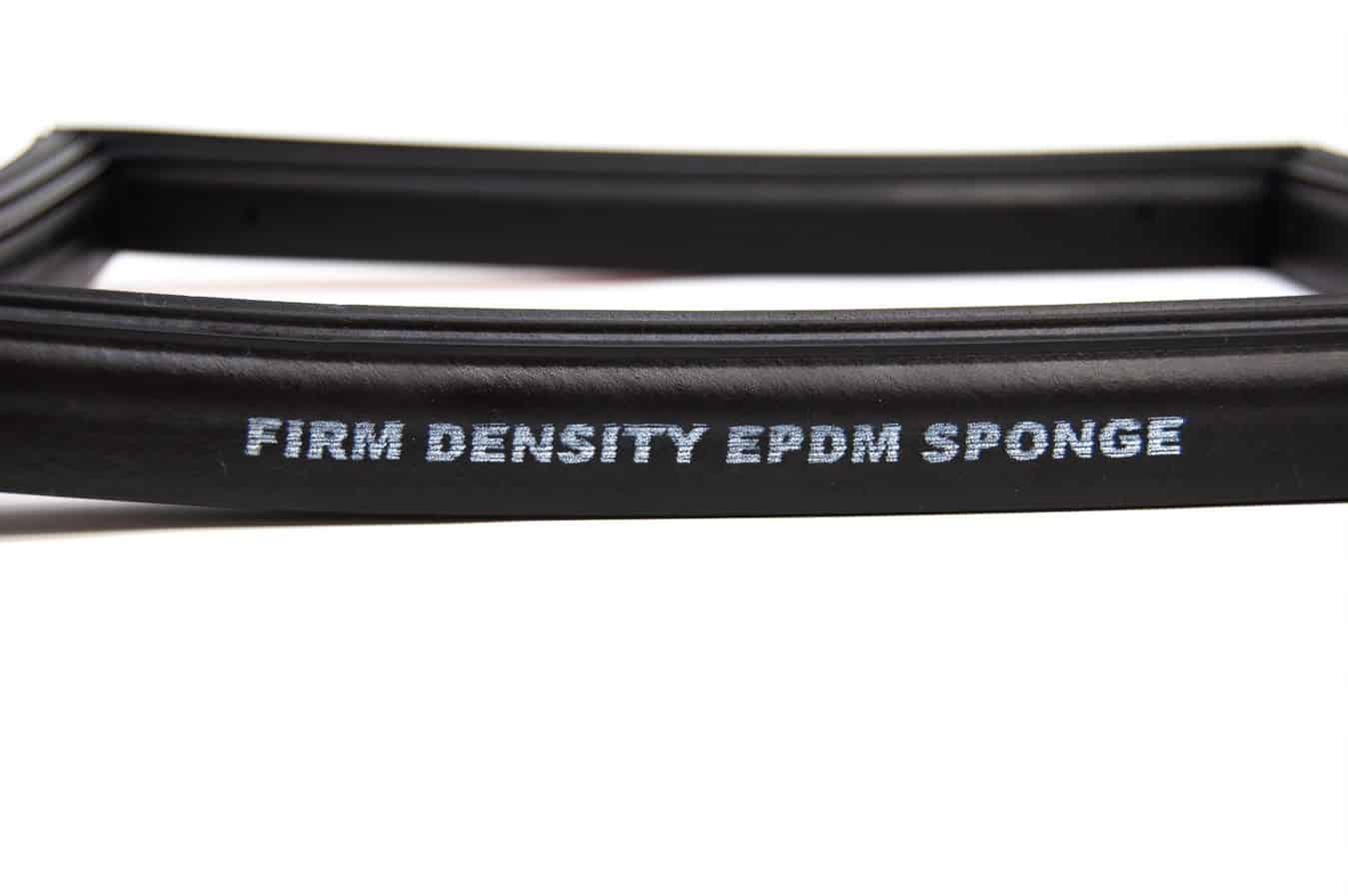
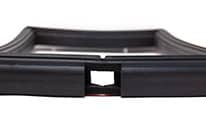
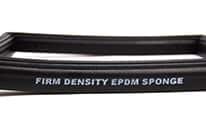
EPDM Gasket Fabrication: Water Jet Cutting, Bonding, Taping

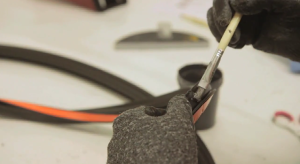
EPDM gasket fabrication supports environmental sealing and electrical insulation. Learn how Elasto Proxy custom fabricates EPDM profiles into finished EPDM rubber gaskets. Then, download the Sealing Essentials E-Book. EPDM gaskets…

Continue ReadingEPDM Gasket Fabrication: Water Jet Cutting, Bonding, Taping

Extruded Rubber Profiles for Custom Seals and Gaskets

Video - Extruded Rubber Profiles
Click to Watch the Video

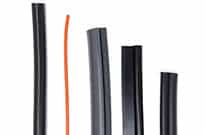
Learn how extruded rubber profiles are made, and how custom fabrication converts elastomeric stock materials into specialty seals and custom gaskets. Click here for Elasto Proxy’s catalog of standard profiles.

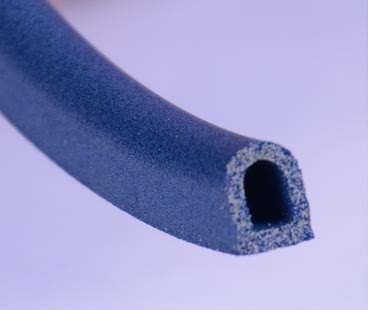
Rubber extrusion is a manufacturing process that creates stock materials or profiles with a fixed cross-section such as a U-shaped channel. First, uncured elastomers are pushed or drawn through a specialized metal tool called a die. Later, the rubber compound is cured through vulcanization, a chemical conversion process that uses heat and sulfur to impart durability and improve mechanical properties.

Rubber extrusion is used with many different types of elastomers, and this rubber manufacturing method supports complex cross-sectional profiles with an excellent surface finish. Because extrusion mixes and blends the raw materials, the cured rubber offers consistent strength and a uniform appearance along the length of the profile. Standards from the Rubber Manufacturers Association (RMA) define part tolerances based on physical dimensions and an RMA class of high precision, precision, or commercial. (more…)

Continue ReadingExtruded Rubber Profiles for Custom Seals and Gaskets

Vulcanized Gaskets and Rubber O-Rings

Hot SplicingLearn about hot splicing for rubber gaskets, and how vulcanization creates O-rings, door gaskets, window gaskets, and other spliced seals.

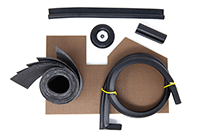
Hot splicing or vulcanization is a cost-effective joining technique for creating continuous seals or endless gaskets from cut lengths of rubber products. First, a heat-activated adhesive is applied to the ends of sponge or solid profiles. In addition to rectangular profiles, rubber products such as round cords, industrial tubing, and irregularly-shaped rubber profiles can be hot spliced, too.

Next, the ends of the profiles are pressed together and placed in a hot mold or vulcanizing press. The heat activates the rubber-based glue, and pressure from the mold or press creates a reliable, attractive joint for continuous sealing. Proper dwell time is important, and hot spliced gaskets should be stored under controlled conditions in warehouse environments according to standards such as DIN 776 or ISO 2230.

(more…)

Continue ReadingVulcanized Gaskets and Rubber O-Rings

EMI Shielding and Conductive Silicones

EMI Gaskets from Elasto Proxy

Particle-filled silicones are elastomeric compounds that combine the advantages of silicone rubber with the electrical properties of metals. In Part 1 of this series, you’ll learn how shielding silicones support custom EMI gaskets.

Silicone rubber is a synthetic elastomer with useful physical and chemical properties over a wide range of temperatures. Silicones resist weathering, ultraviolet light, oxidation, moisture, and many chemicals. Polydimethylsiloxane (PDMS) compounds are also flexible, permeable, and non-irritating to human skin. With applications ranging from medical gaskets and oven seals to building expansion joints and lubricants, silicone rubbers are versatile materials.

(more…)

Continue ReadingEMI Shielding and Conductive Silicones

Chemical Resistance and Rubber Products

Chemical Resistance and Rubber ProductsLearn about the chemical resistance of elastomers used in industrial rubber products.

Clyde Sharpe
General Manager of Elasto Proxy

Rubber products such as seals, gaskets, and hoses are used with many different chemicals. Contact between a rubber product and a chemical can be continuous or intermittent, and may occur at high or low temperatures. For technical buyers and product designers, it’s essential to choose an elastomer that provides the right amount of chemical resistance. It’s also important to understand that other factors, such as chemical concentration and operating temperature, can determine whether a specific rubber is right for your application.

(more…)

Continue ReadingChemical Resistance and Rubber Products

Butyl Rubber Gaskets

Butyl Ruber Applications: Seals and Gaskets

Learn about the properties of butyl rubbers and the applications for butyl rubber seals and gaskets.

Doug Sharpe
President of Elasto Proxy

Did you drive to work today? Maybe you took the bus instead. If your commute involved traveling on tires, then butyl rubber helped get you there. Tires are made of several different elastomers, but butyl plays a special role. Because this synthetic rubber resists the passage of gases, butyl is used for the inner liner, the part of the tire that holds the compressed air. Butyl also resists moisture, and that helps keep the steel belts that are embedded in car, truck, and bus tires from rusting. Butyl resists chemicals, too.

(more…)

Continue ReadingButyl Rubber Gaskets

Cold Bonding for Custom Gaskets

Cold Bonded Gaskets
Cold Bonded Gaskets from Elasto Proxy

Learn how to determine if cold bonding is the right joining or splicing technique for your custom gaskets.

Clyde Sharpe
General Manager at Elasto Proxy

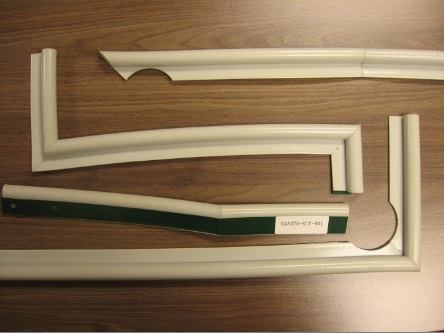
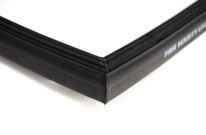
Do you need a custom gasket that looks the corner of a picture frame? L-shaped rubber gaskets require more than just dimensional accuracy. Application requirements and cutting techniques are important to consider, but so is the splicing method. Gasket fabricators use different technologies to join cut lengths into corners, so it’s important to consider all of your available options. In most gaskets designs, the corners are more susceptible to leaks than other parts of the seal.

Cold bonding is a joining method that offers important advantages, but it’s not right for every sealing application. So how can you determine if cold-bonded gaskets are what you need? For starters, let’s define cold bonding and compare it to some “hot” splicing techniques. We’ll also consider cold bonding in terms of application requirements such as performance and cost, and examine how waterjet cutting supports this cost-effective joining method. Finally, we’ll look at gasket assembly.

(more…)

Continue ReadingCold Bonding for Custom Gaskets

High Temperature Thermal Insulation

Learn how to select thermal insulation for ovens, engine bays, and other high-temperature applications.

Clyde Sharpe
General Manager of Elasto Proxy

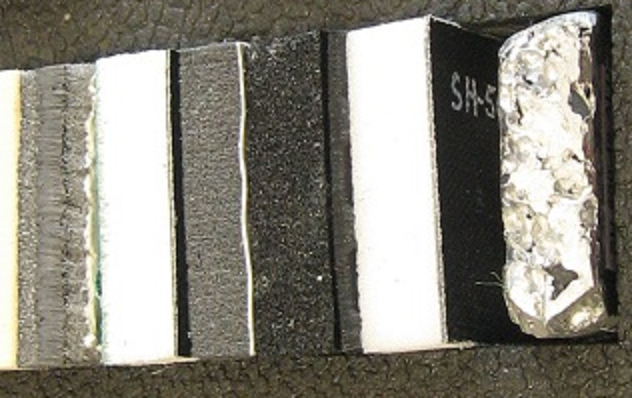
Acoustic and Thermal InsulationThermal insulation is used in high-temperature environments such as ovens and engine compartments. Many different types of materials, including fireproof rubber, are available. Choices include ceramic fiber, fiberglass, mineral fiber, mineral wool, polyurethane, silicone, and various specialty or proprietary materials. As you can see from this list, some thermal insulation is made of polymers. Others, such as metal foils, are not.

Thermal insulation materials come in different forms, too. Choices include boards, blocks, cords, coated fabrics, flexible sheets, foams, paper, and tapes. As a custom fabricator, Elasto Proxy can source thermal protection materials in these and other form factors. We then convert stock items to create specialty thermal insulation that meets all of your application requirements.

For example, using our water jet cutting machine, Elasto Proxy can convert sheets of melamine foam into thermal insulation with specific length and width dimensions. Our skilled production personnel can also convert thin sheets of aluminum foil-faced fiberglass fabric. Sometimes, however, cutting isn’t that all you need. That’s because your application requires more than just thermal insulation.

(more…)

Continue ReadingHigh Temperature Thermal Insulation