Adhesive Taping vs. Mechanical Fastening

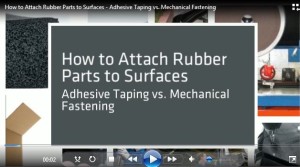
Video: How to Attach Taped Rubber Parts

Learn how adhesive taping attaches rubber parts to plastic, metal, and glass surfaces – and why taped gaskets provide a strong, reliable alternative to mechanical fasteners such as bolts and screws. Then, download the Make It or Buy It? E-Book. 

Rubber parts such as door seals, edge trim, and weather stripping can be attached to plastic, metal, or glass surfaces. Mechanical fasteners like screws and bolts are strong and reliable, but installation is time-consuming. The use of adhesive tapes can speed assembly, but taping also offers other important advantages. By understanding these benefits, and how high-strength adhesive tapes compare to mechanical fasteners, you can choose the best attachment method for your rubber parts. If taping is right for your sealing or insulation application, you can then decide which type of taping you need. (more…)

Continue ReadingAdhesive Taping vs. Mechanical Fastening

EPDM Gasket Fabrication: Water Jet Cutting, Bonding, Taping

EPDM gasket fabrication supports environmental sealing and electrical insulation. Learn how Elasto Proxy custom fabricates EPDM profiles into finished EPDM rubber gaskets. Then, download the Sealing Essentials E-Book. EPDM gaskets…

Continue ReadingEPDM Gasket Fabrication: Water Jet Cutting, Bonding, Taping

Extruded Rubber Profiles for Custom Seals and Gaskets

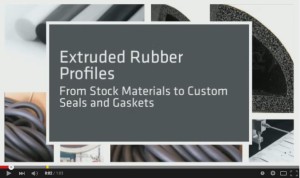
Video - Extruded Rubber Profiles
Click to Watch the Video

Learn how extruded rubber profiles are made, and how custom fabrication converts elastomeric stock materials into specialty seals and custom gaskets. Click here for Elasto Proxy’s catalog of standard profiles.

Rubber extrusion is a manufacturing process that creates stock materials or profiles with a fixed cross-section such as a U-shaped channel. First, uncured elastomers are pushed or drawn through a specialized metal tool called a die. Later, the rubber compound is cured through vulcanization, a chemical conversion process that uses heat and sulfur to impart durability and improve mechanical properties.

Rubber extrusion is used with many different types of elastomers, and this rubber manufacturing method supports complex cross-sectional profiles with an excellent surface finish. Because extrusion mixes and blends the raw materials, the cured rubber offers consistent strength and a uniform appearance along the length of the profile. Standards from the Rubber Manufacturers Association (RMA) define part tolerances based on physical dimensions and an RMA class of high precision, precision, or commercial. (more…)

Continue ReadingExtruded Rubber Profiles for Custom Seals and Gaskets

Military Rubber Gasket Specifications

Military GasketsLearn about military specifications for rubber gaskets, and why defense contractors need a custom fabricator that can do more than convert elastomeric materials.
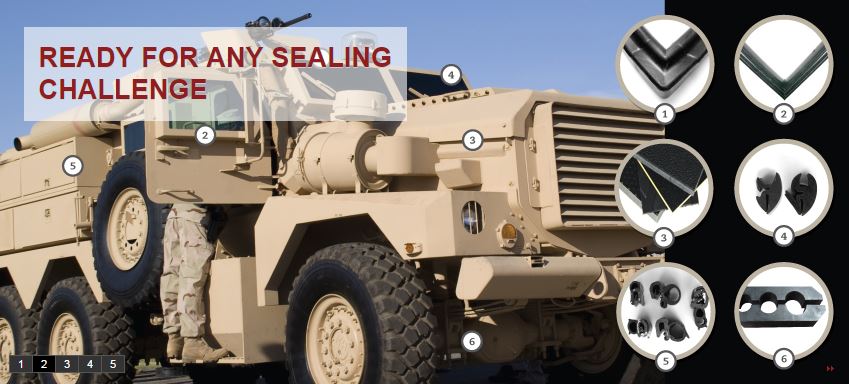

Military specifications for rubber gaskets are designed to ensure that elastomeric materials support the mission by meeting published performance requirements. Standards and specifications for the U.S. military are authorized by the Department of Defense (DOD), and used by defense contractors throughout North America. Tier 1 and Tier 2 suppliers are familiar with these standards, but may not fully understand how the details of a particular specification can affect purchasing and manufacturing decisions.

Official DOD definitions specify many different document types, but the format of each military standard generally begins with the letters “MIL”. For the defense supply chain, however, complying with what’s inside the standard is what matters. With rubber gaskets, buyers need to choose materials that meet or are tested to published requirements for properties such as hardness and oil-resistance. In addition, elastomeric gaskets for defense-related applications must be custom fabricated to exacting tolerances.

Let’s take a look at two military standards for rubber gaskets: MIL-R-900F and MIL-G-1149C. First, however, we’ll examine a related standard for non-metallic gasket materials.

(more…)

Continue ReadingMilitary Rubber Gasket Specifications

Military Gasket Design

Military GasketsMilitary gaskets for armored vehicles must account for media, temperature, application, and pressure (MTAP). Defense contractors are familiar with acronyms like MRAP, but gasket designers who include MTAP in their seal designs help support the mission.

Clyde Sharpe
General Manager of Elasto Proxy

Have you ever wondered why the military uses so many acronyms? Soldiers, sailors, airmen, and marines need to convey information quickly, accurately, and efficiently. Suppliers to the defense industry are also more likely to hear a term such as “MRAP” than the phrase “mine-resistant ambush-protected vehicle”.  For defense contractors who want to do business with military buyers, mastering these acronyms can be learning a new language. The process may be challenging at times, but the rewards are worth it.

Like any specialized discipline, gasket design has its own language, too. For example, many rubber gaskets are made of synthetic elastomers with names such as Buna-N and EPDM. Published specifications such as ASTM D2000 use letters and numbers to “call out” the properties of vulcanized rubber in a highly-structured way. Units of measure such as durometer (hardness) are sometimes unfamiliar, so buyers and designers may need assistance in order to translate the language of rubber into project specifications.

(more…)

Continue ReadingMilitary Gasket Design

Chemical Resistance and Rubber Products

Chemical Resistance and Rubber ProductsLearn about the chemical resistance of elastomers used in industrial rubber products.

Clyde Sharpe
General Manager of Elasto Proxy

Rubber products such as seals, gaskets, and hoses are used with many different chemicals. Contact between a rubber product and a chemical can be continuous or intermittent, and may occur at high or low temperatures. For technical buyers and product designers, it’s essential to choose an elastomer that provides the right amount of chemical resistance. It’s also important to understand that other factors, such as chemical concentration and operating temperature, can determine whether a specific rubber is right for your application.

(more…)

Continue ReadingChemical Resistance and Rubber Products

Butyl Rubber Gaskets

Butyl Ruber Applications: Seals and Gaskets

Learn about the properties of butyl rubbers and the applications for butyl rubber seals and gaskets.

Doug Sharpe
President of Elasto Proxy

Did you drive to work today? Maybe you took the bus instead. If your commute involved traveling on tires, then butyl rubber helped get you there. Tires are made of several different elastomers, but butyl plays a special role. Because this synthetic rubber resists the passage of gases, butyl is used for the inner liner, the part of the tire that holds the compressed air. Butyl also resists moisture, and that helps keep the steel belts that are embedded in car, truck, and bus tires from rusting. Butyl resists chemicals, too.

(more…)

Continue ReadingButyl Rubber Gaskets

Cold Bonding for Custom Gaskets

Cold Bonded Gaskets
Cold Bonded Gaskets from Elasto Proxy

Learn how to determine if cold bonding is the right joining or splicing technique for your custom gaskets.

Clyde Sharpe
General Manager at Elasto Proxy

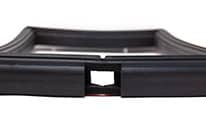
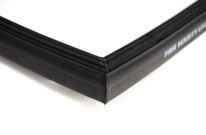
Do you need a custom gasket that looks the corner of a picture frame? L-shaped rubber gaskets require more than just dimensional accuracy. Application requirements and cutting techniques are important to consider, but so is the splicing method. Gasket fabricators use different technologies to join cut lengths into corners, so it’s important to consider all of your available options. In most gaskets designs, the corners are more susceptible to leaks than other parts of the seal.

Cold bonding is a joining method that offers important advantages, but it’s not right for every sealing application. So how can you determine if cold-bonded gaskets are what you need? For starters, let’s define cold bonding and compare it to some “hot” splicing techniques. We’ll also consider cold bonding in terms of application requirements such as performance and cost, and examine how waterjet cutting supports this cost-effective joining method. Finally, we’ll look at gasket assembly.

(more…)

Continue ReadingCold Bonding for Custom Gaskets