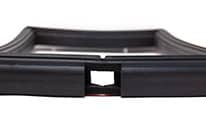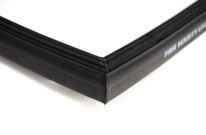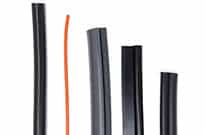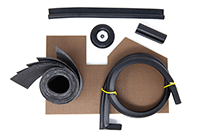
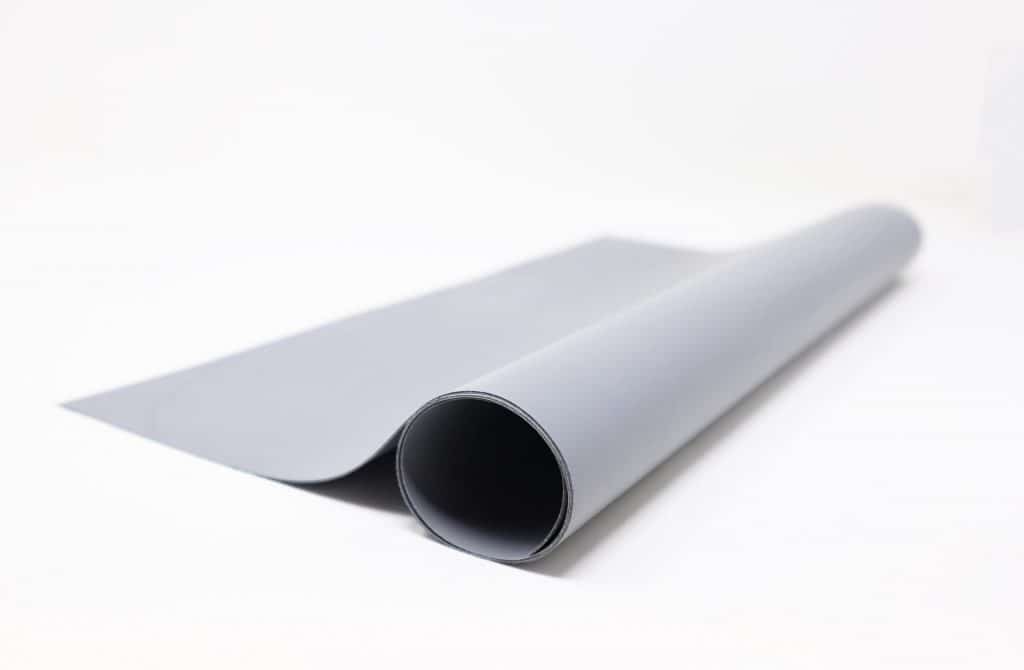
Rubber sheeting is a flat, flexible material used for sealing and insulation. Because rubber sheets are elastomeric, they deform under stress and then return to their original shape when the force is removed. For example, rubber sheeting that’s converted into flat gaskets is compressed between two surfaces to form a seal. The rubber then returns to its original thickness when the load is removed.
Elasto Proxy distributes industrial rubber sheeting, but we also convert rubber sheet materials into custom products like latch gaskets and headliners. Sometimes, we laminate sheet materials together before using our water jet cutter to create specific shapes. We can also apply adhesive backings for the peel-and-stick installation of finished parts.
This article explains where rubber sheeting is used and how to select it. You’ll also learn more about Elasto Proxy’s fabrication capabilities, which can turn stock materials into custom products. Keep reading to learn more and contact us when you’re ready to discuss your application. We specialize in low-to-medium volumes and combine custom fabrication with value-added services.
What Is Rubber Sheeting and How Is It Used?
Rubber sheeting consists of continuous, flat rolls or cut lengths of elastomeric materials that are produced through calendering or continuous vulcanization. They’re available in different material types (compounds), durometers (hardnesses), thicknesses, and finishes. Typically, rubber sheets are fabricated into custom components rather than used in their original form.
Applications vary by industry, but some finished parts are used across multiple sectors. For example, mobile equipment and military land systems both use engine bay insulation and headliners. Similarly, food processors and medical manufacturers both use flat gaskets made from rubber sheets that meet requirements from the U.S. Food and Drug Administration (FDA).
Common Compounds
Selecting the right rubber sheeting means comparing your application’s requirements to the material’s properties. Here’s a list of compounds that Elasto Proxy commonly fabricates.
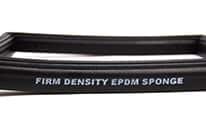
- EPDM provides superior resistance to ozone in the air, ultraviolet light (UV) from the sun, water, and weather. It also resists steam and outdoor temperatures.
- Neoprene withstands outdoor environments and combines moderate mechanical strength with oil resistance.
- Nitrile is the industry standard for petroleum, fuel, oil, and hydraulic fluid resistance unless a more expensive elastomer such as fluorosilicone or Viton® (FKM) is required.
- Silicone withstands a wide range of temperatures, including heat and cold that other rubbers can’t resist. It’s also stress-absorbing and water-resistant.
- Natural Rubber provides excellent tensile strength, elasticity, and tear resistance for dynamic mechanical applications.
Each of these compounds also has disadvantages, which is why it pays to ask Elasto Proxy for advice during material selection. In addition to evaluating tradeoffs, you’ll need to consider key rubber sheeting specifications.
Key Specifications
Elasto Proxy fabricates rubber materials in various durometers, a measure of hardness expressed on the Shore A scale. Depending on the application, you might need a soft and highly conformable sheet material with a durometer of 30 Shore A. For high load applications, you might need rigid rubber sheeting with a durometer of 90 Shore A instead.
Thickness and dimensions are also key specifications. Standard rubber sheeting has thicknesses that range from thin membranes of 1/32 in. (0.79mm) to heavy-duty pads of 2 inches (5.08 cm) or more. The size of the sheet (length and width) determines its suitability for applications such as the large headliners in heavy equipment cabs or the smaller latch gaskets used on service truck doors.
Don’t forget color and finish. Standard industrial rubber is black, but sheet materials are available in a rainbow of colors. That includes white, which is often used in food or medical environments. Finish affects appearance, but it’s not just about aesthetics. For example, a smooth finish reduces friction while a textured surface improves traction.
Regulatory requirements and industry standards are also important considerations. FDA rubber is used in food contact applications, but mass transit applications may require rubber sheeting that meets flame, smoke, and toxicity (FST) requirements from Bombardier instead. Underwriters Laboratories (UL) also defines flammability requirements.
Fabrication Methods: Transforming Sheets Into Custom Products
Elasto Proxy uses water jet cutting, lamination, and adhesive backings to transform rubber sheeting into custom products. The value we provide includes services like ordering all the rubber sheets that you’ll need for a year, storing them in our warehouses, fabricating your products, and then shipping them on-demand or according to your sales forecasts.
Water Jet Cutting
Water jet cutting uses a high-pressure stream of water to slice through rubber sheeting with speed and precision. Unlike die cutting, which is also used with sheet materials, there’s no tooling to wait for or pay for. Water jet cutting is ideal for rapid prototyping and for low-to-medium volumes of parts, including components with complex geometries and intricate features.
Elasto Proxy can water-jet-cut flat gaskets made from a single material, but we also fabricate engineered components made from multiple materials – including pressure-sensitive adhesive backings (PSA) that have a release liner. With multi-layer constructions, we perform lamination or apply PSA backings first, and then water-jet-cut your parts or products.
Lamination and PSA Backings
Some applications need rubber products with properties that a single elastomeric layer just can’t provide. Examples include thermal, acoustic, and thermal-acoustic insulation. Through lamination, Elasto Proxy bonds rubber sheeting to complementary substrates. This includes sheet materials like closed-cell silicone foams, but it can also include non-elastomers like metal foils.
For example, Elasto Proxy specializes in thermal-acoustic insulation that maximizes sound attenuation across a broad frequency range. Our ZTBRA products place a vibration damper between layers of acoustic foam and add a metal foil facing to reflect radiant heat. We can also add a PSA backing with a release liner for peel-and-stick installation that save you time during assembly.
Ask Elasto Proxy for Rubber Sheeting
Rubber sheeting is a starting point for sealing and insulation solutions. Whether you need flat gaskets made from a single material or custom insulation that features a multi-layer construction, Elasto Proxy is the fabricator you need. In addition to services like water jet cutting, lamination, and adhesive backings, we can help you with material selection, warehousing, logistics, and more.