How does Elasto Proxy make rubber gaskets? As an engineer or buyer, you may already know which type of rubber material you need. However, understanding how that rubber is fabricated is also important. That’s because the way a gasket is converted from a stock material into a finished part effects sealing performance, lead times, production costs, and assembly efficiency.
At Elasto Proxy, we typically cut rubber materials with water jet equipment. This tool-less process is fast, efficient, and doesn’t require metal dies. It won’t burn or deform gasket edges either. With sheet materials, we can apply an adhesive backing to help you speed gasket installation. We can also apply adhesive tapes to extruded profiles and bond cut lengths into frame-style gaskets.
This article examines how rubber gaskets are made and considers the advantages of water jet cutting. It also describes fastening options and reviews the different ways that Elasto Proxy bonds cut lengths into finished gaskets like door and window seals. Keep reading to learn more and contact us to discuss your application.
Stock Materials: Rubber Sheets vs. Extrusions
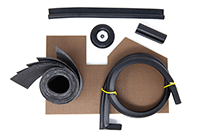
Before fabrication begins, Elasto Proxy buys stock materials in two main forms: rubber sheets and extruded profiles.
- Rubber Sheets (and Rolls) are used for flat, two-dimensional gaskets. They’re available in a variety of compounds and as solid, sponge, or foam materials. Rubber sheets vary in terms of durometer (hardness), thickness, and compliance with standards or specifications.
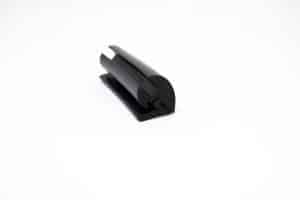
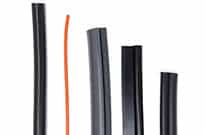
- Extruded Profiles are used for three-dimensional gaskets and can include features such as lips or channels. Like rubber sheets, extrusions come in a variety of compounds and as solid or cellular materials. They also vary in terms of durometer, thickness, and compliance.
Water Jet Cutting: Precision without Tooling
Water jet cutting is used to convert both types of starting materials into gaskets with precise dimensions. Unlike die cutting, which requires waiting for and paying for metal tooling, water jet cutting is a digital manufacturing process driven by your computer-aided design (CAD) file.
Elasto Proxy’s water jet equipment uses a high-pressure stream of water to cut through rubber materials without distorting their edges. Pure water jet machines are used for softer materials, sponge rubber, and thinner solid sheets. Abrasive water jet cutting introduces fine garnet particles into the stream and is used for cutting denser or thicker materials.
There are other ways to cut rubber materials, but water jetting offers these advantages.
- Tight Tolerances and Precision: Water jet cutting maintains tight tolerances on complex geometries. It cuts rubber materials with far greater precision than manual cutting.
- Clean Hole Cutting: For flat gaskets, water jet cutting creates clean bolt-holes, internal cutouts, and intricate sealing paths without crushing or deforming rubber materials.
- Bevels and Angle Cutting: Water jet equipment can produce bevels, angles, countersinks, and mitered ends on rubber sheets or extruded profiles.
- No Heat-Affected Zone (HAZ): Because water jet cutting is a cold cutting process, it doesn’t generate heat like laser cutting. This prevents material burning, melting, hardening, or toxic fume generation.
- Fast Prototyping and Parts Nesting: Engineers can quickly go from a CAD drawing to prototype part. With low-to-medium volume fabrication, nesting software optimizes part layout on rubber sheets to minimize material waste and lower total project costs.
Adhesive Backings and Gasket Taping: Speeding Installation
Rubber gaskets don’t require an adhesive backing, but Elasto Proxy can apply one to help you speed product assembly. With flat gaskets, adhesive backings are laminated onto rubber sheets before water jet cutting occurs. Extruded gaskets can use a pressure-sensitive adhesive (PSA) tape or a heat-activating taping system (HATS).
Why use adhesive backings or tapes? They hold gaskets in place and keep them from slipping before plastic or metal fasteners are installed. Elasto Proxy works with various types of adhesives and can apply unsupported tapes, supported tapes, specialized adhesives to your custom gaskets. We can also help you to evaluate your fastening options.
- Unsupported Tapes (Transfer Tapes) have a pure layer of acrylic or rubber adhesive supported by a release liner. They’re thinner and conform to irregular surfaces.
- Supported Tapes (Double-Sided Tapes) have a carrier film that’s coated with adhesive on both sides. The carrier adds dimensional stability and can help prevent soft rubber gaskets from excessive stretching during installation.
- Specialty Adhesives include high-tack acrylics and silicone PSAs. High-tack acrylics provide strong adhesion to metals and powder-coated plastics. Silicone-based PSAs are used with high-temperature silicone rubber sheets.
Gasket Bonding: Joining Cut Lengths Together
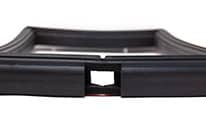
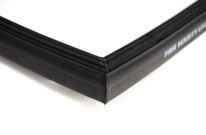
Extruded gaskets are produced by cutting coils of rubber into lengths of a specific size. The ends can be joined in a continuous loop, such as with O-rings, or bonded together at the corners, such as with frame-style gaskets. Elasto Proxy offers a choice of bonding methods and can help you select the best one for your application.
Hot Splicing
Hot splicing uses heat, pressure, and a thin polyethylene (PE) film splice to join the cut ends of extruded profiles. Traditional heating elements or infrared (IR) light is used.
- Conventional Splicing is ideal for solid rubber and silicone profiles. It uses heat and pressure to melt a film splice between clean, mitered, or straight cut-ends.
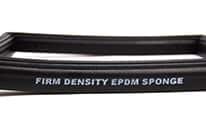
- Infrared (IR) Splicing is recommended for sponge rubber profiles because IR energy targets the splice without scorching the rubber. It also accommodates larger profiles and requires minimal post-production trimming.
Vulcanization
Vulcanization joins the ends of rubber profiles by using heat, pressure, and an uncured rubber compound made of the same elastomer as the profile itself. Uncured rubber is applied to the joint faces, and the assembly is pressed together inside a heated mold.
Vulcanization has longer cycle times than hot splicing, but it’s more forgiving of any issues with cut quality. Plus, it provides excellent chemical and physical continuity across the joint. Applications include hollow tubing and specialized O-rings.
Cold Bonding
Cold bonding is a manual joining technique that applies a liquid adhesive or glue to cut ends at room temperature and without external heat. These glues include cyanoacrylates (instant glues), industrial silicones, and two-part epoxies for specific rubber materials.
Because cold bonding doesn’t require metal dies or heating equipment, it’s a cost-effective solution for prototypes and lower volumes. However, cold-bonded joints typically offer less long-term durability and environmental resistance.
Molding
Molding is used to join complex gasket corners and bulb trim profiles. Cut ends are placed in a C-press injection mold where a compatible rubber compound is injected under high-pressure to form a strong, solid corner.
Molding is the only bonding method capable of creating fully-rounded radius corners or shapes with complex transitions. When rubber gaskets undergo significant stretching or compression during installation, molded corners provide superior joint strength, tear resistance, and leak prevention.
Choose Value-Added Gasket Fabrication
Fabricating reliable rubber gaskets is about more than choosing the right rubber material. At Elasto Proxy, we use water jet cutting for both sheet materials and extruded profiles. We can also apply an adhesive so that your gaskets arrive ready to install. With extruded gaskets, we offer a choice of bonding methods – including corner molding.
Whether you need flat gaskets for flange faces or extruded gaskets for the doors and windows on heavy equipment cabs, you’ll find that Elasto Proxy is much more than a gasket fabricator. We’re a value-added manufacturing partner with services that include design reviews and material selection assistance. Ready to learn more?