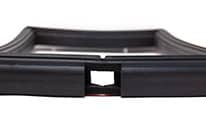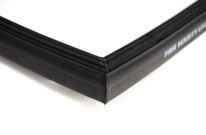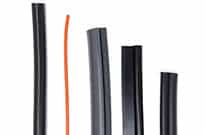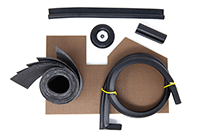
Elasto Proxy fabricates door and hatch seals for military land systems. We are AS9100D and ISO9001:2015 certified and hold a Canadian Controlled Goods Certificate.
Door and hatch seals for military land systems help protect crews and onboard electronics from outdoor environments. They keep out dust, dirt, debris, and water while resisting shock, vibration, chemicals, and temperature extremes. These industrial rubber products must also withstand compression set – permanent deformation that can occur when a compressive force is removed.
For more than 35 years, Elasto Proxy has provided defense contractors with dependable sealing and insulation solutions. For example, when a Canadian defense contractor wanted to replace military vehicle hatch seals that were over-compressed, we replaced their neoprene gaskets with silicone foam seals that rebounded to their original thickness, even at higher temperatures.
This article covers door and hatch seal requirements and describes seal design, material selection, fabrication, and installation considerations. Whether you’re designing a seal for a new platform or need to replace an existing gasket, Elasto Proxy is ready to support your mission. Keep reading to learn more and contact us for a quote or to discuss your application.
Door and Hatch Seal Requirements
In military land systems, doors and hatches aren’t just access points. They’re structural interfaces that must maintain their integrity under harsh environmental conditions.
As part of these larger assemblies, door and hatch seals must:
- Compress uniformly, avoid over‑compression, and maintain their geometry even when exposed to extreme heat, cold, or mechanical stress.
- Resist outdoor environmental conditions such as ultraviolet (UV) light from the sun, ozone from the air, wind, water, and precipitation.
- Maintain pressure boundaries for onboard HVAC, CBRN filtration, and crew‑compartment overpressure systems.
- Withstand thousands open‑and‑close cycles without losing their elasticity or sealing force
- Resist tearing, pulling, stretching, and abrasion.
Depending on a seal’s function and location, resistance to fuels, oils, hydraulic fluids, cleaning agents, and decontamination chemicals may also be required.
Environmental and Operational Challenges
Specific environments and operational conditions can pose unique sealing challenges.
- Desert conditions: Fine sand can infiltrate crew compartments and damage electronics.
- Arctic climates: Rubber must remain flexible at extremely low temperatures.
- Tropical environments: Humidity, mold, and sunlight can accelerate material degradation.
- High‑shock environments: Repeated impacts and vibration can cause seal fatigue
Seal failure under any of these conditions can compromise crew safety, reduce vehicle readiness, or lead to costly maintenance. That’s why seal design, material selection, fabrication quality, and installation-readiness are all mission-critical. Elasto Proxy can help you at every step of the way.
Seal Design
Elasto Proxy doesn’t design door or hatch seals for military land systems; however, the design reviews we offer can help you achieve sealing success. At our Montreal-area headquarters, we use SolidWorks to analyze compression behavior, identify strain points, and optimize seal geometry before fabrication begins.
We also review your seal designs for dimensional tolerances – allowable variations in part or material size. Sometimes, engineers specify tolerances that are fine for metal parts but too tight for rubber products. By reviewing your drawings, blueprints, or CAD files for design for manufacturability (DFM), we can help you to avoid expensive re-designs and project delays.
Material Selection
Material selection is one of the most important factors in seal performance. That’s why Elasto Proxy created MTAP, an easy-to-remember acronym that engineers can use when evaluating seal materials.
- Media (M): The substances the seal will touch, such as fuels, cleaning chemicals, water, or extreme weather conditions.
- Temperature (T): The normal operating temperatures as well as extreme highs, lows, and potential thermal aging.
- Application (A): The function and environment of the seal (e.g., whether it’s for a door gasket, a hatch gasket, or another type of rubber component).
- Pressure (P): The pressures the rubber part must withstand. In the case of military and systems, this typically refers to crew compartment over-pressure.
Elasto Proxy can help you apply MTAP to your design and will also analyze your compression requirements and installation constraints. Many door and hatch seals are made of EPDM rubber, but silicones and fluorosilicones are needed for some applications.
EPDM
EPDM is widely used for exterior seals because of its excellent resistance to UV, ozone, and weather. It remains flexible across a broad temperature range and performs well in wet or humid environments. For doors and hatches exposed to the elements, EPDM is often the preferred choice.
Silicone
Silicone offers exceptional temperature resistance and long‑term elasticity, making it ideal for extreme hot or cold climates. It’s commonly used in military land systems that are deployed in arctic regions or high‑heat environments where standard elastomers may stiffen or degrade.
Fluorosilicone
Fluorosilicone combines silicone’s temperature resistance with enhanced resistance to fuels, oils, and solvents. It’s ideal for chemically aggressive environments, such as engine‑bay access hatches or fuel‑system service doors.
Custom Fabrication
Elasto Proxy fabricates low‑to‑medium volumes of door and hatch seals for military land systems. We support defense programs from prototyping through production and offer cutting, bonding, and assembly methods that produce gaskets without long lead times or tooling charges.
Water Jet Cutting
Water jet cutting uses a high-pressure stream of water to makes clean, precise cuts without tooling. It’s ideal for initial prototypes, engineering changes, and ongoing production. Water jet cutting process converts rubber extrusions into cut lengths with smooth edges and consistent dimensions.
Hot Splicing
Hot splicing creates strong, uniform joints that eliminate weak points in the corners. That’s critical for door and hatch seals that must maintain continuous compression. Hot splicing ensures that the cut lengths we join behave as a single, continuous component.
Cold Bonding
Cold bonding is a manual process where skilled operators apply a liquid adhesive to the cut ends of an extrusion. The type of rubber determines the adhesive chemistry. Because cold bonding doesn’t require metal tooling, it’s best for low volumes.
Molding
Molding is the only joining method that creates rounded corners, yet it’s also ideal for 90-degree corners that will be stretched or pulled. Molding requires metal tooling and a C-frame injection molding press, but it’s recommended for seals where leak resistance is critical.
PSA and HATS Taping
Pressure‑sensitive adhesive (PSA) and heat‑activated taping systems (HATS) allow door and hatch seals to be installed quickly and accurately on the assembly line or in the field. Taped gaskets help reduce installation time and can be used without or without fasteners.
Door and Hatch Seal Installation
Most door and hatch seals are attached using a combination of adhesive tapes, mechanical retention features, and fasteners or channels built into the vehicle structure. Bulb‑trim profiles often rely on integrated metal carriers that grip the flange without additional hardware. In high‑load or high‑vibration areas, seals may be secured with push‑in clips, rivets, or bolted retainers.
During design reviews, Elasto Proxy evaluates not only your seal geometry and material selection but also the installation method you plan to use. By understanding how the seal will be installed, we can recommend adjustments to durometer, profile shape, joining method, and adhesive selection to ensure reliable compression, ease of installation, and long‑term durability.
Supporting Military Vehicle Manufacturers
Elasto Proxy makes custom seals for military land systems, but the value we provide doesn’t end there. In addition to supply-chain support, warehousing, and logistics, we offer:
- One‑off components for prototypes
- Limited‑quantity production runs
- Spare parts for legacy platforms
- Kitting and packaging for assembly‑line efficiency
Through design reviews, material selection, quality fabrication, and installation advice, Elasto Proxy delivers sealing solutions that enhance vehicle performance, reduce lifecycle costs, and support the demanding requirements of military programs.