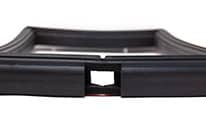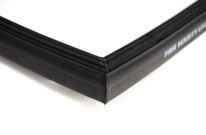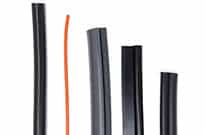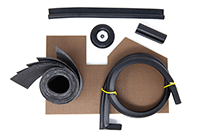
Do you need food grade silicone for a fabricated product like an oven seal, a baking mat, or the water line for a coffee machine? Then begin by understanding that the term “food grade silicone” doesn’t have a single definition. Rather, it varies with the food contact rules that apply where the silicone product will be sold and used. The “where” in the previous sentence involves geography and jurisdiction, but there’s more to it than that.
FDA Regulations and Food Grade Silicone
In the United States, there’s a section in the code of federal regulations (CFR) that governs rubber articles intended for repeated use with food. The U.S. Food and Drug Administration (FDA) maintains this section, 21 CFR 177.2600, and enforces it. FDA approved silicones have been thoroughly tested by an FDA agent or expert, but that still might not be enough for the food grade silicone that you need.
NSF Standards and Food Grade Silicone
Depending on your application, standards from NSF International may also apply. NSF International isn’t a regulatory agency like the FDA; however, your customer may require you to use silicones that meet voluntary standards from this public health organization. NSF International maintains over 100 public health standards, but two are especially important when it comes to food contact. NSF 51 applies to food equipment materials, and NSF 61 is for contact with potable water.
U.S. Standards and Canada
NSF 51 is also known as NSF/ANSI 51 because it’s used by the American National Standards Institute (ANSI) while NSF 61 is also known as NSF/ANSI/CAN 61 because it was jointly developed by ANSI and the Canadian Standards Association (CSA). Here, it’s worth noting that while the U.S. FDA’s 21 CFR 177.2600 does not directly apply in Canada, adherence to this FDA regulation in Canada (and to NSF standards) may be used to demonstrate the safety of food contact materials.

NSF/ANSI 51 and Food Equipment Materials
NSF/ANSI 51 sets minimum requirements for materials (such as silicones) that are used in commercial food equipment such as prep tables, mixers, and dispensers. This voluntary standard restricts the use of materials that contribute harmful substances under conditions of use. In the food service industry, silicone gaskets and tubing are often specified to NSF 51. This is in addition to adherence to FDA 21 CFR 177.2600, which is a legal requirement.
NSF/ANSI/CAN 61 and Drinking Water System Components
NSF/ANSI/CAN 61 establishes minimum health-effect requirements for chemical contaminants and impurities that are indirectly imparted to drinking water from products, components, or materials used in potable water systems. It applies not only to water dispensers, but also to coffee machines and filtration housings. Certification is product-specific and formulation-specific, and the NSF maintains a public listing of NSF 61 certified materials.

NSF Certified Silicones vs. NSF Compliant Silicones
Just as there’s a difference between FDA approved silicones and FDA compliant silicones, there’s a difference between silicones that are NSF certified vs. NSF compliant.
- NSF certified silicones have been independently tested to NSF 51 or NSF 61. Products bear an official NSF certification mark.
- NSF compliant silicones have not been independently tested, and products do not bear an official NSF mark. In other words, the manufacturer alone makes this claim.
Importantly, the terms “NSF 51 approved” and “NSF 61 approved” are not used by NSF International. Companies sometimes use these terms to indicate a product meets NSF 51 or NSF 61 standards, but their claims lack verified, independent proof and an official certification.
What About Europe?
As in Canada, FDA 21 CFR 177.2600 does not have a direct legal standing in Europe. Because there is no European Union (EU) wide regulation, companies show compliance by adhering to Framework Regulation (EC) 1935/2004, GMP Regulation (EC) 2023/2026, and typically national measures such as Germany’s BfR Recommendation XV. Materials and products that are sold both in North America and Europe may need to meet these standards as well as FDA 21 CFR 177.2600 and NSF 51 or 61.

Do You Need Help Selecting Food Grade Silicones?
Elasto Proxy helps food equipment manufacturers select the food grade silicones that they need. As a rubber fabricator and distributor, we work with a global network of trusted material suppliers and offer food grade silicone products like seals, gaskets, and tubing in low-to-medium volumes. By partnering with Elasto Proxy and treating “food grade silicone” as a project deliverable instead of a black-and-white definition, you can get what you need.