Elasto Proxy attended DSEI 2025 in London, United Kingdom, from September 9th to 12th. The Defense and Security Equipment International (DSEI) show is held biennially and is one of the world’s largest tradeshows for the defense and security industry. This year’s event was the biggest yet with 30,000 visitors, 1600 exhibitors, and 100,000 square meters of floor space.
Preparing the Future Force
The theme of DSEI 2025, “Preparing the Future Force,” was fitting because of the show’s emphasis on emerging defense technologies. There was a wide range of more traditional military equipment, of course, but artificial intelligence and uncrewed systems complemented ground vehicles and battleships. There was also a strong focus on local partnerships and self-sufficiency.

Five Lessons for Defense Contractors
Elasto Proxy’s Stijn Verschueren, our branch manager in Europe, and François Charreton, our branch manager in Quebec, learned five lessons that can benefit your business. Keep reading to find out what they are, and contact us for military rubber products that provide environmental sealing, thermal management, EMI shielding, shock and vibration control, and fire safety.
1. Artificial Intelligence is everywhere.
Artificial intelligence (AI) isn’t just housed in military data centers. Increasingly, AI is supporting faster and more effective decision making across land, air, sea, and space domains. At DSEI 2025, Elasto Proxy watched demonstrations that showed how AI is being integrated into satellites, sonar, drones, and command-and-control platforms.

2. Buyers want uncrewed systems that are light, stealthy, and sustainable.
DSEI 2025 showcased advances in uncrewed systems, which are sometimes called drones or unmanned systems instead. Investments in these technologies are growing rapidly, and military buyers want vehicles that are quiet and lightweight. Hybrid systems promote greater battlefield integration, and technologies made from less expensive materials can support military sustainment.

3. Ground Vehicles keep improving.
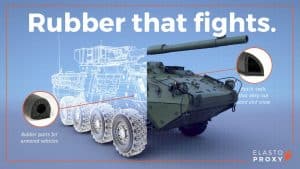
Advances in ground vehicles were on full display. For example, one family of versatile, highly mobile, and battle-proven transports that traces its origins to the 1980s now uses silicone sheeting to protect soldiers’ knees and absorb ballistic impacts. There are also technology transfers from industries such as automotive and robotics. Validating brand-new vehicles can be extensive, and the process may be spread over long periods of time, but Elasto Proxy welcomes these opportunities.

4. Naval defenses are integrated and increasingly autonomous.
DSEI 2025 included large battleships, but naval defenses now include smaller autonomous surface vessels (ASVs), hull-mounted sonar systems, sonobuoys for submarine detection, and towed acoustic arrays for submarine and torpedo detection. Elasto Proxy’s first customer was a shipbuilder, and it’s remarkable how far the industry has advanced in 35 years.

5. Local sourcing can support greater self-sufficiency.
In Europe, there’s a new sense of urgency about achieving supply chain self-sufficiency. That’s especially true in the defense sector, where there’s renewed interested in partnerships that are more local or regional in nature. With our North American and European branches, distributed network of suppliers, and deep experience in the defense industry, Elasto Proxy is well-positioned to support the mission wherever it leads.
Does your business support the defense industry? For military rubber products that provide environmental sealing, thermal management, EMI shielding, shock and vibration control, and fire safety, ask Elasto Proxy.