Data center cooling systems need sealing and insulation that supports thermal efficiency, uptime, and power usage effectiveness (PUE). Fans, pumps, chillers, and coolant distribution units (CDUs) are critical, but they need reliable rubber products like hoses, hose connectors, gaskets, O-rings, expansion joints, dynamic seals, and grommets.
Elasto Proxy supplies these and other data center parts for both air-cooled and liquid-cooled facilities. Whether you’re planning a new build or a retrofit, we’re your one-stop shop for custom sealing and insulation. Keep reading to learn more and contact us for a quote. Our capabilities include fabrication, distribution, and value-added services like help with material selection.
Why Data Centers Need Rubber Products for Cooling
Data centers generate significant heat because they use large amounts of electricity. Unless this heat is managed properly, server electronics can degrade or fail. In data center cooling systems, rubber products provide both environmental sealing and thermal insulation. Product selection is a function of system requirements for media, temperature, application, and pressure (MTAP).
Air Cooling vs. Liquid Cooling
Data centers can be air-cooled, liquid-cooled, or use a combination of technologies.
- Air-cooled data centers use air conditioning units and fans to circulate cold air through server racks. The air absorbs the heat from IT equipment. This hot air is exhausted through conduits in raised floors or aisles. Enterprise data and edge centers are typically air cooled.
- Liquid-cooled data centers use liquid coolants such as water, glycol, silicone oil, or dielectric fluids to remove heat from high-density IT equipment. Liquid cooling is more efficient than air cooling and is used in data center retrofits and hyperscale data centers.
Liquid Cooling Methods
Liquid-cooled data centers use three main liquid cooling methods.
- Direct-to-chip (D2C) cooling circulates a coolant through cold plates attached to high-heat components. The coolant passes through the plate, absorbs the heat, and is pumped away. DTC cooling is often used in data center retrofits.
- Immersion cooling fully submerges servers in a liquid coolant to remove heat from more than just “hot spots”. This technique offers maximum cooling efficiency and supports the highest server densities required for artificial intelligence (AI) workloads.
- Rear door heat exchangers (RDHx) are liquid-cooled doors that are mounted on the back of server racks. They remove heat directly from its source by passing hot air exhaust through coolant-filled coil.
Elasto Proxy supplies industrial rubber products for all these data center cooling systems.

Air Cooling Systems: Sealing for Airflow Management
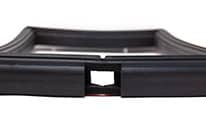
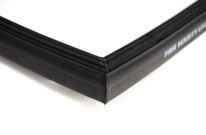
Air cooled data centers need rack gaskets, floor grommets, and door and panel seals for proper airflow management.
- Rack gaskets seal gaps around and within server cabinets to prevent the mixing of incoming cold air and outgoing hot air. These rubber parts prevent cold air from bypassing IT equipment and hot air from returning to the front of the server rack.
- Floor grommets seal cable cutouts to prevent the escape of cold air from the underfloor plenum. These molded rubber parts improve static pressure, ensure efficient airflow, and help eliminate hot spots.
- Door and panel seals help maintain pressure differentials in aisle containment systems. They’re used with cabinet doors, bases and bottoms as well as with side panels, vertical mounting rails, and aisle containment doors.
Liquid Cooling Systems: Sealing for Leak Prevention
Liquid cooled data centers need hoses and hose connectors, O-rings, dynamic seals, and expansion joints for leak prevention.
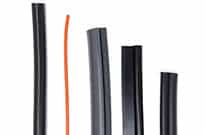
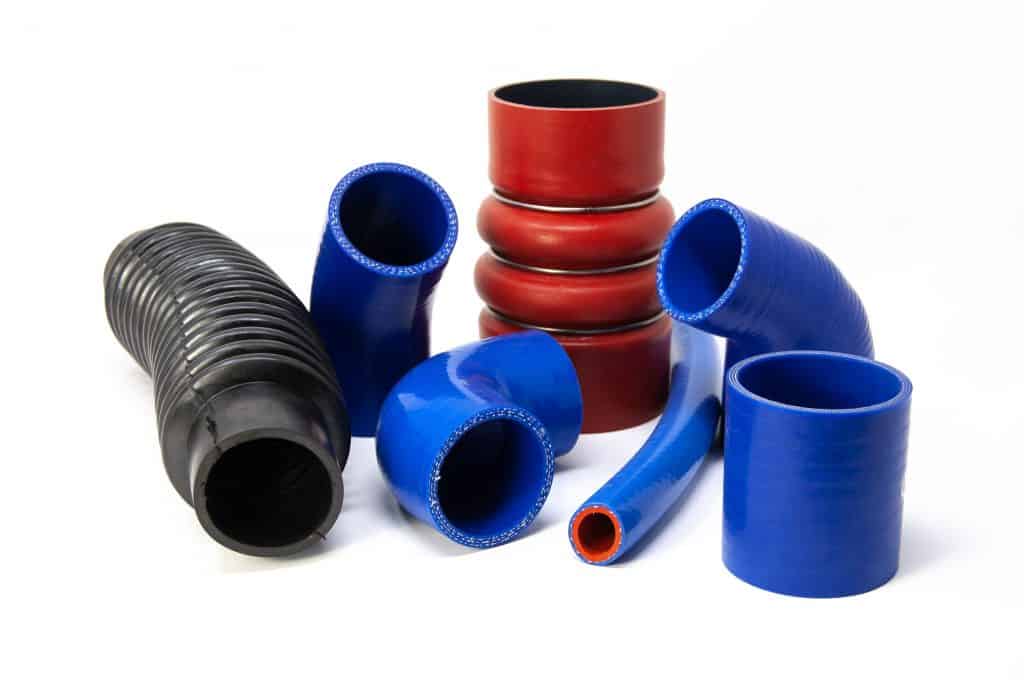
- Hoses and hose connectors convey liquid coolants. EPDM is used for water-based cooling loops and silicone with the glycol or silicone-based coolants used in D2C cooling and with CDUs. Siicone resists higher temperatures and a broader range of temperatures than EPDM.
- O-rings are used in liquid cooling loops and must withstand thermal cycling and exposure to water, glycol, silicone oil, or other fluids. They’re used in quick-connect couplings, pump housings, manifolds, and heat exchanger fittings.
- Dynamic seals are used with rotating shafts to create a barrier between moving and stationary parts. They maintain data center cooling system integrity by sealing in lubricants and sealing out contaminants.
- Expansion joints function as flexible connectors. They absorb thermal contraction and expansion, preventing damage to rigid pipes and electrical systems caused by temperature fluctuations.
Thermal Insulation: Material Selection and Data Center Cooling System Efficiency
When it comes to cooling efficiency, vapor barrier integrity is even more important than R-value: a measure of a material’s ability to resist heat flow. In chilled-water systems, insulation failure is primarily a moisture-control problem. That’s because when chilled lines operate below the dew point, vapor barrier discontinuities allow water vapor to penetrate and condense on pipe surfaces.
Once condensation begins, the following problems can occur.
- Corrosion under insulation (CUI) accelerates
- Insulation becomes saturated and loses thermal performance
- Microbial growth increases maintenance risks
- Dripping water threatens electronics and flooring
This is why closed‑cell foams are used thermal insulation. Their fully enclosed cellular structure also forms an integrated vapor barrier, eliminating the need for external jacketing.
NBR/PVC Foams
NBR/PVC foam is a blend of nitrile butadiene rubber (NBR) and polyvinyl chloride (PVC). This flexible, conformable foam has low water vapor permeability and can meet ASTM C534 requirements for elastomeric insulation. NBR/PVC foams are ideal for chilled-water systems and are cost-efficient.
EPDM Foams
Compared to NBR/PVC foams, EPDM foam provides better resistance to ultraviolet (UV) and higher temperatures. EPDM has a slightly higher permeability than NBR/PVC.
Best Practices for Sealing and Insulation in Data Center Cooling Systems
Follow these best practices to optimize data center cooling.
Maintain Vapor Barrier Continuity
- Use closed‑cell elastomeric insulation
- Seal all seams, joints, and terminations
- Inspect for compression damage or UV degradation
- Avoid mixed‑material insulation systems unless they’re engineered for compatibility
Design for Maintainability
- Use quick‑connect fittings with replaceable O‑rings
- Select hoses with bend‑radius compliance
- Ensure expansion joints are accessible for inspection
Validate Material Compatibility
- Match elastomers to coolant chemistry
- Confirm fire‑rating requirements for plenums
- Use conductive elastomers where EMI shielding is required
Partner with Elasto Proxy
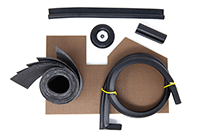
Elasto Proxy supplies parts for data center cooling, including seals, gaskets, and thermal insulation in low-to-medium quantities. We can also supply you with molded rubber parts like hoses and grommets in whatever quantities you need . Contact us to request a quote or for more information.