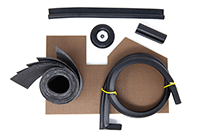
Elasto Proxy fabricates engine bay insulation and heat shields for military land systems in Canada, the United States, Europe, and beyond.
Even during peacetime deployments, military land systems face harsh conditions. Their diesel engines generate intense heat, high decibel levels, and continuous vibrations. Without proper engine bay insulation and heat shielding, thermal and acoustic loads can compromise crew safety, reduce mission effectiveness, degrade onboard electronics, and increase detectability by infrared sensors.
For over 35 years, Elasto Proxy has provided defense contractors with thermal‑acoustic insulation, heat shields, and environmental sealing for military land systems. This article explains how we fabricate engine bay insulation and heat shielding for military vehicle manufacturers. Keep reading to learn more and contact us for a quote or to discuss your application.
Engine Bay Insulation for Military Land Systems
Elasto Proxy is AS9100D and ISO 9001:2015 registered, holds a Controlled Goods Certificate (CGS), and is a woman-owned business that can help Canadian defense contractors meet their ITB/VP requirements. The engine bay insulation that we custom-fabricate serves multiple functions.
Thermal Protection and Heat Management
The diesel engines that power military land systems run extremely hot. Without proper thermal insulation, heat radiates through the firewall and surrounding structures, raising cabin temperatures and forcing HVAC systems to work harder. This increases fuel consumption and reduces operational range. Excessive heat also elevates the vehicle’s thermal signature.
Elasto Proxy fabricates thermal‑acoustic insulation with foil facings that reflect radiant heat and help maintain a lower external thermal signature. These multi-layer composites use silicone foam or another high-temperature material as their core. Elasto Proxy can also apply high-temperature pressure-sensitive adhesive (PSA) tapes to support installation.
Acoustic Control and Crew Safety
Engine noise that exceeds safe exposure limits can interfere with crew communications and increase the risk of long‑term hearing loss among warfighters. MIL‑STD‑1474E is a U.S. military standard that defines noise exposure limits, measurement methods, and acoustic performance requirements across military vehicles. Canada and other NATO countries reference this standard.
Elasto Proxy makes acoustic insulation that can help you comply with MIL‑STD‑1474E and related standards such as ISO 11201, ISO 3744, and NATO’s STANAG 2294. Open‑cell acoustical foams, vinyl sound blockers, and composite materials with a sandwich-like structure absorb and block engine noise that would otherwise reach the crew cab.
Protecting Onboard Electronics
Modern land systems carry extensive electronic content such as systems for navigation, communication, targeting, and power management. Heat is the enemy of reliable electronics, but noise and vibration can also shorten component life or cause intermittent failures. That’s bad news in battlefield environments, and when repair facilities and replacement parts are far away.
Thermal‑acoustic insulation from Elasto Proxy helps stabilize temperatures and can include vibration‑damping layers that reduce shock loads. For example, a combination of silicone foam, metal foil, and mass-loaded vinyl can handle high heat while protecting sensitive electronics from shock. Sometimes, melamine or polyimide foam and aluminized films are used instead.
Chemical, Fluid, and Wash‑Down Resistance
Military vehicles are cleaned with power‑washing and exposed to fuels, oils, detergents, and hydraulic fluids. Insulation materials must resist chemical degradation and maintain structural integrity during repeated wash‑downs, including engine bay cleanings. Foams, foils, facings, and other materials that can’t withstand these conditions can compromise mission readiness.
Standard polyurethane foams with Mylar facings sometimes fail under these conditions. That’s why Elasto Proxy offers a combination of silicone‑based foams and specialized facings that can withstand both high temperatures and harsh cleaning cycles. As a long-time member of the defense supply chain, we specialize in solving challenges like this.
Material Technologies for Engine Bay Insulation
Elasto Proxy fabricates engine bay insulation from a variety of high-temperature foams, facings and films, and adhesives for temporary or permanent fastening.
High‑Temperature Foams
Engine bay insulation typically incorporates one or more of the following materials:
- Silicone foam: High‑temperature resistance (up to ~400°F), excellent compression set, hydrophobic, weather‑resistant, and difficult to ignite.
- Melamine foam: Lightweight, excellent acoustic absorption, and inherently flame‑resistant.
- Polyimide foam: High‑temperature stability and low outgassing for sensitive electronics.
These materials can be layered together to create composite structures that meet specific thermal, acoustic, and environmental requirements. Fiberglass composites are used as well.
Facings and Films
Facings determine how insulation interacts with heat, fluids, and abrasion. Choices include:
- Aluminum foil: Reflects radiant heat and provides a moisture barrier.
- Neoprene or specialty elastomer facings: Resist oils, fuels, and cleaning chemicals.
- Heat‑resistant films: Improve durability and flame resistance.
For example, Elasto Proxy’s ZMT insulation combines a silicone foam, neoprene facing, aluminum foil, and PSA tape to deliver a balanced thermal‑acoustic solution.
Adhesives and Attachment Systems
Engine bay insulation must remain securely attached despite heat, vibration, and fluid exposure. Elasto Proxy uses:
- Laminated bonding for multi‑material composite structures.
- High‑temperature PSA tapes, typically with silicone on one side and acrylic on the other.
We can also recommend adhesives that resist solvents and detergents, or that comply with flame, smoke and toxicity (FST) requirements.
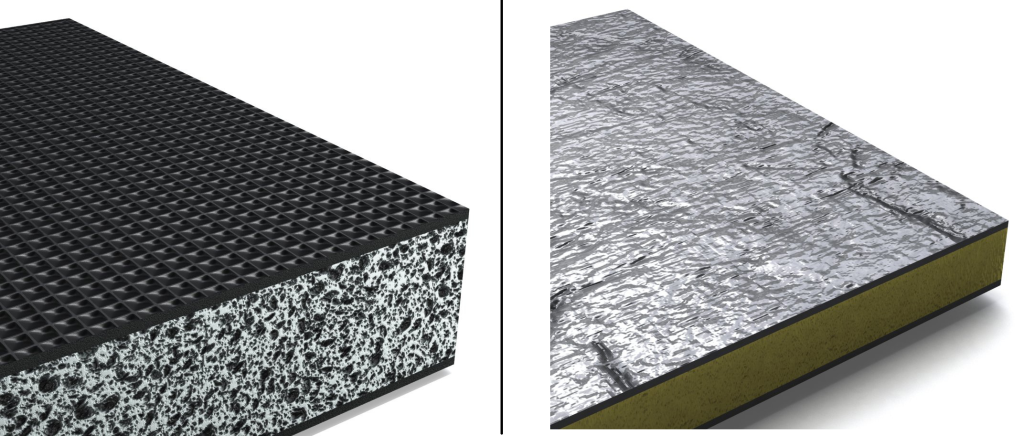
Engine bay insulation (left) and heat shield (right) from Elasto Proxy.
Heat Shields for Military Land Systems
Heat shields provide localized protection around exhaust manifolds, turbochargers, after‑treatment systems, and high‑temperature zones.
Heat Shield Functions
These custom-fabricated parts:
- Reflect radiant heat away from sensitive components
- Protect wiring harnesses, sensors, and electronics
- Reduce thermal soak into the crew compartment
- Lower the vehicle’s infrared signature
Elasto Proxy fabricates flexible heat shields rather than all-metal products. Our solutions typically incorporate aluminum-foil-faced fiberglass or silicone-coated fabrics.
Integration with Insulation Systems
In many military vehicles, heat shields and engine bay insulation work together. Heat shields manage peak temperatures, and thermal insulation manages sustained thermal loads.
Fabrication Capabilities and Value-Added Services
Elasto Proxy fabricates engine bay insulation by laminating sheet materials together and then water jet cutting the laminates into custom shapes and sizes. We can also apply PSA tapes and offer value-added services like kitting and custom packaging.
- Lamination joins foams, films, and facings into multi‑layer “sandwiches”. At Elasto Proxy, we ensure uniform thickness, strong bonds, and consistent performance across the entire insulation panel.
- Water jet cutting produces clean, accurate cuts without tooling costs or long lead times. It’s ideal for rapid prototyping, design iterations, complex geometries, and low-to-medium volumes.
- Taping speeds insulation, especially when PSA adhesives are used to create peel-and-stick solutions.
- Kitting reduces SKUs and simplifies ordering, receiving, inventory management, and accounting across your operation.
- Custom packaging combines related parts into a single shipment. Elasto Proxy can even package them in assembly order so that the part to install first is on top.
Meeting Military Requirements
Engine bay insulation and heat shields are mission-critical components in modern military land systems. They protect crews, safeguard electronics, reduce thermal signatures, and improve the overall performance of military vehicles.
Through design reviews, material selection, precision fabrication, and decades of defense‑industry experience, Elasto Proxy provides engine bay insulation and heat shields that meet the extreme demands of military environments. We also provide other types of military land system parts for sealing and insulation.
Whether you’re designing a new vehicle platform or upgrading an existing fleet, our engineered insulation and heat‑shielding is essential to achieving reliability, survivability, and mission readiness. We’ve been serving the defense industry for over 35 years. How can we help you?