Do you need a vibration mount for mobile equipment, a machine, or a vehicle you’re designing? Elasto Proxy provides anti-vibration mounts for these and other applications. We also fabricate custom gaskets, thermal and acoustic insulation, and other rubber and plastic parts for original equipment manufacturers (OEMs) in Canada, the United States, and Europe.
This article is designed to provide engineers with answers to frequently asked questions (FAQs) about vibration mount selection. It complements Elasto Proxy’s Ultimate Guide to Vibration Mounts, where you’ll find product types and other information. Keep reading to learn more and contact Elasto Proxy for a quote.
What is a vibration mount?
A vibration mount is a rubber‑to‑metal bonded assembly that’s designed to isolate a system from vibration, shock, and noise. The rubber is molded over or bonded to a metal component such as a plate, stud, or insert. Specialized adhesives or vulcanization create a high-strength bond between the rubber and the metal.
Vibration mounts dissipate energy generated by pumps, motors, compressors, engines, fans, and other rotating or reciprocating machinery. The rubber absorbs this energy and the metal provides structural support. By protecting the surrounding system from vibrations, these products reduce wear, improve operator comfort, and protect sensitive components such as electronics.
How does a vibration mount work?
A vibration mount provides an interface between the source of vibrations and the structure (such as a machine frame or vehicle body panel) to which it’s attached. As the mount vibrates, the rubber deforms and converts the vibration’s kinetic energy into low-level heat that’s dissipated. Most of the vibration’s mechanical energy is absorbed, but some is transferred into the surrounding structure.
That’s why vibration mounts also prevent vibration amplification (i.e., damping). When a vibration is amplified, there’s an increase in the maximum distance that an object moves from its resting position. For an example, think of a washing machine that moves during its spin cycle. As a vibrating system absorbs more energy, the results include louder sounds and increased structural stress.
What’s the difference between vibration damping and vibration isolation?
Vibration damping and vibration isolation are related, but they’re not the same.
- Vibration damping dissipates vibratory energy within the mount material. Damping reduces amplitude, but it doesn’t necessarily isolate the system.
- Vibration isolation reduces the transmission of vibrations between structures. It’s most effective when the excitation frequency is much higher than the mount’s natural frequency.
Most vibration mounts provide both damping and isolation.

What is natural frequency and how is it related to structural resonance?
Every object (e.g., a machine frame) has a natural frequency at which it tends to vibrate when disturbed. Structural resonance refers to how vibrations amplify when the frequency of an external force (e.g., vibrations from a motor) matches an object’s natural frequency.
Which problems do vibration mounts address?
Vibration mounts address the following engineering challenges.
- Premature wear and fatigue in bearings, welds, fasteners, and housings
- Noise, vibration, and harshness (NVH) in vehicles and machinery
- Operator discomfort due to transmitted vibrations
- Damage to electronic components and solder joints
- Unplanned downtime caused by vibration‑induced failures
- Structural resonance that amplifies vibration instead of damping it
What are some different types of vibration mounts and where are they used?
Engineers can choose from a wide range of standard types or styles. Here are a few options.
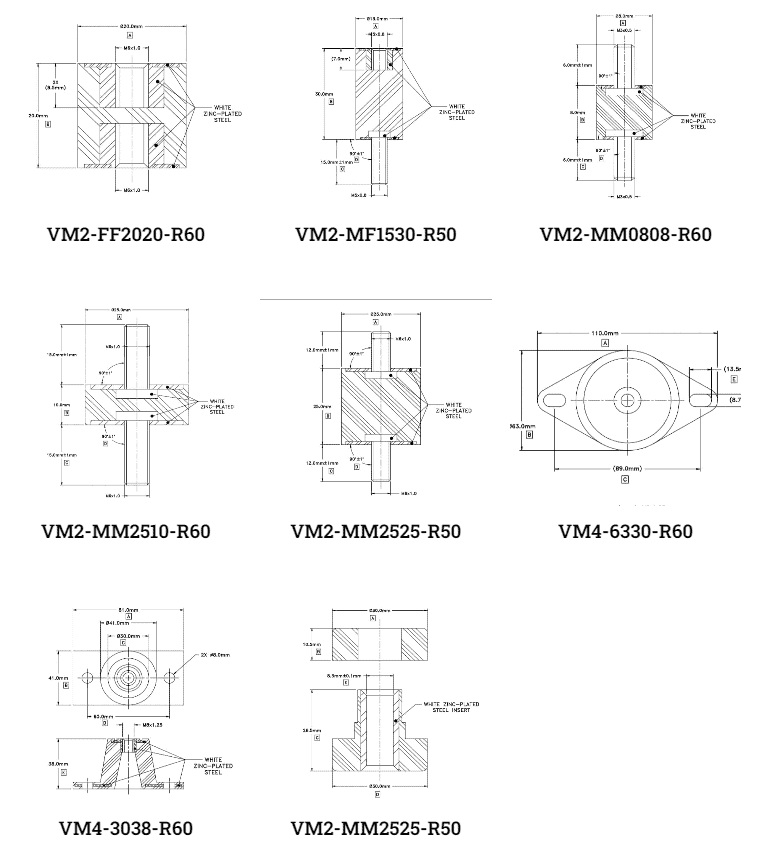
- Cylindrical (Bobbin) mounts are typically used with machinery.
- Conical mounts are often used in engines and cabs.
- Machine mounts (leveling mounts) are used with industrial equipment that requires height adjustments, such as when the factory floor isn’t level.
See Elasto Proxy’s Ultimate Guide to Vibration Mounts for additional options and more information. We can also provide you with custom vibration mounts to meet application-specific challenges.
Which rubber materials are used in vibration mounts?
Commonly used rubber materials include:
- Natural Rubber (NR) for elasticity
- Neoprene (CR) for resistance to oil, sunlight, and ozone
- Nitrile (NBR) for resistance to oil, but not sunlight and ozone
- EPDM for strong UV, ozone, and weather resistance
- Silicone for environments with a wide range of temperatures
Elasto Proxy invited an acronym called MTAP to help engineers with material selection based on Media (M), Temperature (T), Application (A), and Pressure (P).

How do I select the right vibration mount for my application?
Understanding the operating environment is essential, but engineers also need to account for the following factors:
- Static load: The weight the mount must support
- Dynamic load: Forces generated during operation
- Natural frequency: The mount must provide isolation above the resonant frequency
- Deflection requirements: How much movement is acceptable
- Shock requirements: The ability to absorb sudden impacts
- Mount orientation: This depends on the type of loads
Engineers often use load‑deflection curves, stiffness data, and damping coefficients to model system behavior and predict isolation performance.
What’s the difference between static and dynamic loads?
Static loads involve the constant, fixed weight of equipment, such as an industrial machine on a cement floor. Dynamic loads are time-varying, rapid forces. For an example, think of a gravel-filled dump truck traveling on an uneven dirt road. In applications like vehicle suspensions, vibration mounts must withstand significant dynamic loads.
What are the specific types of loads that vibration mounts face?
These are the main types of loads that engineers need to consider during product selection.
- Compression: The mount is squeezed, such as between a machine and factory floor.
- Shear: Applied forces cause adjacent parts to slide in opposite directions.
- Tension (Tensile): The rubber material is pulled or stretched
- Torsion: Twisting forces are applied to the mount, such as from rotating machinery
- Buckling: Overloading during compression risks causing a mount to bend sideways
- Dynamic and Shock: Rapidly applied, unpredictable forces can cause failure
How long do vibration mounts last?
Service life depends on the load, the environment, and the material. Specific factors include:
- High temperatures that accelerate elastomer aging
- Exposure to chemicals the rubber doesn’t withstand
- UV and ozone degradation if the rubber isn’t for outdoor use
- Overloading or repeated shock events during normal use
- Dynamic fatigue from continuous vibrations
In mild or predictable environments, vibration mounts can last many years. In harsh or unpredictable environments, however, periodic inspection is recommended and replacement may be required.
What are some signs that a vibration mount needs to be replaced?
Engineers should look for:
- Cracks or tears in the elastomer
- Separation between the rubber and metal
- Permanent deformation or sagging of the rubber material
- Increased noise or vibration during operation
- Visible oil or chemical damage, such as cracking
- Metal‑to‑metal contact that indicates bottoming-out
Regular inspection helps to prevent equipment damage and unplanned downtime.
How does Elasto Proxy support vibration mount selection?
Elasto Proxy provides:
- Standard vibration mounts in multiple sizes and configurations
- Custom products for specific loads or mounting geometries
- Material selection assistance, including help with compounds and durometers
- Design reviews for drawing elements such as rubber tolerances.
- Prototyping and low‑to‑medium volume production
Ready to learn more? Contact Elasto Proxy to discuss your application.