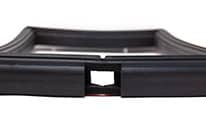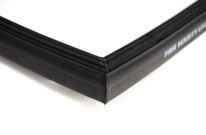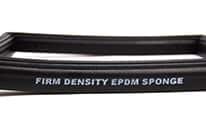
Nuclear glovebox window gaskets create an airtight, leak-tight seal that prevents unfiltered air from escaping and outside air from entering. They support the glovebox’s negative pressure system, help absorb stresses and vibrations, and support the safe handling of hazardous nuclear materials. Elasto Proxy makes nuclear glovebox window gaskets and works closely with industry partners.
Today, glovebox manufacturers have a choice of gasket fabrication processes. However, many choose extruded gaskets that are molded in the corners. That’s because corner-molded gaskets are less expensive to produce than gaskets that are fully molded. By choosing corner molded products, engineers can get nuclear glovebox window gaskets that are strong where it matters most.
How to Join Nuclear Glovebox Window Gaskets
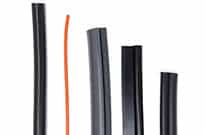
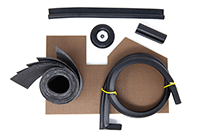
At Elasto Proxy, window gasket fabrication begins when we use water jet cutting to convert coils of rubber into cut lengths. There’s no tooling to wait for or pay for, and water jet equipment makes quick, clean cuts that won’t put pressure on and deform the rubber profile. These high-quality cuts support different types of bonding, but corner molding produces the strongest joints.
Each of our injection molding machines have a heated barrel, two metal plates (i.e., the top and bottom halves of the mold), and tons of pressure. First, uncured rubber is heated and pushed through a barrel by a screw. This molten rubber flows into channels on the bottom plate or mold half. There, cut lengths of a solid rubber profile are positioned so that they are parallel to each other.
After the molten rubber flows into this part of the mold, a moveable plate with additional cut lengths of rubber presses down on the bottom plate. In the top half of the mold, cut lengths are positioned so that they’re perpendicular to the bottom halves. By assembling the two halves of the mold together, a gasket with a picture frame shape can be formed.
Next, hydraulic pressure is applied. The corners are created, the top plate or mold half is removed, and cooling occurs. The same rubber compound and durometer are used for both the profile and the molded corners, and Elasto Proxy then tests these gaskets in accordance with a procedure that we’ve developed with Paragon Energy Solutions, a leading supplier to the nuclear power industry.

How to Test Nuclear Glovebox Window Gaskets
This process for testing nuclear glovebox window gaskets has five parts or steps.
- Fit-up testing
- Dimensional testing
- Visual inspection
- Lot or batch control
- Measuring and test equipment
These following sections explain.
1. Fit-Up Testing
Fit-up testing is performed before final assembly of the window and flange is complete. By proactively addressing defects like misalignment and cracking, it ensures seal integrity and helps avoid time-consuming or costly field repairs once a glovebox is installed. The window gasket is tested for stretching without tearing, and in accordance with an American Glovebox Society (AGS) recommendation that window openings have tolerances of 1/8” per foot.
2. Dimensional Testing
Within fit-up testing, 100% dimensional testing is critical. That’s why it’s embedded in the glovebox manufacturing process and incorporates go / no-go decision-making. Part drawings need to include Rubber Manufacturers Association (RMA) tolerances, which are less precise than the tolerances used for machined metal parts. Among the RMA’s four classes, however, there are high precision (AI) and precision (A2) classes.
3. Visual Inspection
Visual inspection is performed in parallel with dimensional testing. The goal is to find any voids, flash, or other defects that indicate poor-quality molded corners. During corner molding, flash is caused by insufficient clamping force, mold damage, or incorrect process settings. This excess rubber protrudes from the gasket and must be removed. Flash is functional problem that can interfere with sealing and assembly, but it can be easily addressed with hand trimming.

4. Lot or Batch Control
Elasto Proxy asks material suppliers for a Certificate of Conformance (COC) that includes lot or batch control. Suppliers that issue COCs affirm that a product meets specific standards, regulations, or specifications (such as ASTM D2000). Because window gaskets with molded corners consist of two materials – the extrusion and the corner – a COC for both materials is required. The goal is to ensure that the same rubber recipe was used for both.
5. Measuring and Test Equipment
Verifying the consistency of the durometer is essential, especially near the gasket’s joints. That’s why Elasto Proxy uses measuring and test equipment (M&TE) to verify consistency between a gasket’s corners and across orders over time. Nuclear glovebox window gaskets are critical to safety and performance, and every part of the process testing process must ensure quality, consistency, and reliability.
Ask Elasto Proxy for Nuclear Glovebox Window Gaskets
Elasto Proxy makes nuclear glovebox gaskets and can help you with material selection and design reviews. We specialize in low-to-medium volumes and fabricate industrial rubber products in accordance with our ISO 9001:2015 certified quality management system. If you’re a nuclear glovebox manufacturer, we invite you to contact us to discuss your sealing application or to request a quote.