Agricultural robots are changing the way that crops are planted, monitored, managed, and harvested. Agribots, as these machines are also known, are used in orchards, vineyards, row‑crop fields, greenhouses, and vertical farms. Unlike industrial robots that operate in controlled environments, agricultural robots must withstand water, ultraviolet light (UV), soil, mud, ozone, vibration, biological contaminants, and temperature swings.
Most agribots have electric motors and actuators for motion, gearboxes and linkages for mechanical power transmission, sensors for navigation and detection, and embedded electronics for control. Power systems range from lithium ion batteries to hybrid energy modules. Some outdoor robots have wheels, but others have continuous tracks with tank treads for movement over terrain. Agricultural robots that are stationary instead of mobile are typically used with indoor farming instead.
Each agribot subsystem needs materials that can withstand tough environments while enabling repetitive but precise operations such as planting, watering, weeding, pruning, and picking. Within these subsystems, rubber and plastic parts play a key role in ensuring durability, safety, and long‑term performance. These components are used for protection and flexibility, sealing and insulation (including thermal management and EMI shielding), and shock absorption and tracking.
Elasto Proxy supplies rubber and plastic parts for agricultural robots and can support projects from prototyping through production. Keep reading to learn more and contact us for a quote.
Elasto Proxy is both a fabricator and a distributor. We’re your one-stop shop for rubber and plastic parts for agricultural robots.
Protection and Flexibility
Agricultural robots need to move through fields, orchards, vineyards, and greenhouses without damaging crops of injuring workers. Their internal systems also require protection against environmental conditions. Rubber and plastic parts include protective covers and bumpers, cable and hose management components, and joint and actuator bellows.
Protective covers and bumpers include arm bumpers, end-effector guards, chassis edge protectors, and wheel and track shrouds. Materials include EPDM, thermoplastic elastomers (TPE), and polyurethane. EPDM resists sunlight, ozone, water, and weather. TPEs can absorb impacts, and polyurethane’s (PU) abrasion resistance can withstand soil and debris.
Cable and hose management parts include flexible cable carriers, strain-relief boots, grommets and bushings, and tubing and conduits. Because agricultural robots have power cables, sensor wiring, and hydraulic or pneumatic lines, rubber and plastic parts must flex repeatedly without fatigue. Silicone combines flexibility with temperature stability, nylon provides strength and wear resistance, and thermoplastic urethane (TPU) is abrasion resistant.
Joint and actuator bellows protect against dust, mud, and moisture while allowing a full range of motion. Examples include linear actuator bellows, rotary joint covers, and telescoping arm boots. Neoprene is flexible and chemical resistant. TPUs have high tear strength. Silicone-coated fabrics are used for large bellows that require heat-resistance.

Sealing and Insulation for Agricultural Robots
Agricultural robots have electronics and sensors that require environmental sealing, protection against heat and electrical current, and shielding against electromagnetic interference (EMI). Three major types of rubber and plastic parts are used: environmental seals and gaskets, thermal and electrical insulation, and EMI shielding.
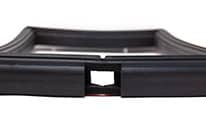
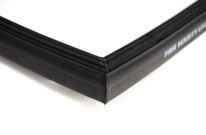
Environmental seals and gaskets for agribots include enclosure gaskets, access panel seals, battery compartment gaskets, and O-rings for sensor housings. Some rubber and plastic parts need to support sealing with specific levels of Ingress Protection (IP), such as IP65. EPDM and silicones are used commonly. Nitrile (NBR) rubber is recommended where there’s fuel or oil exposure.
Thermal and electrical insulation can withstand heat from motors and inverters or provide electrical isolation to prevent short circuits. Insulating pads for power electronics and wire harness insulation are two examples. Silicone foam provides thermal insulation, polyimides offer high-temperature insulation, and glass-filled nylon is used for structural components that also require dielectric strength.
EMI shielding is essential because agricultural robots use GPS, LiDAR, machine vision, and wireless communications systems that are susceptible to electronic interference. Parts such as electrically conductive EMI shielding gaskets block or attenuate electromagnetic noise from motors, switching power supplies, and external source. Silicones filled with metal or metal-coated particles can be fabricated into EMI shielded enclosure gaskets.

Shock Absorption and Traction
Whether they’re wheeled or tracked, agricultural robots are subject to shock and vibration. That’s a problem since agribots need stable mounting and vibration isolation to help protect GPS, inertial measurement units (IMUs), encoders, and machine vision sensors. Vibration isolators and mounts; wheel, track, and tread parts; sensor mounting components, and impact absorbers are used.
Vibration isolators and mounts reduce transmitted vibrations to protect mechanical structures and sensors. Examples include motor mounts, gearbox isolators, and chassis vibration pads. Natural rubber (NR) combines vibration damping with high elasticity. SBR provides cost-effect protection against moderate vibration. Polyurethane is used where high load capacity is required.
Wheel, track, and tread parts for agricultural robots provide grip and stability in mud, loose soil, gravel, or uneven terrain. Rubber and plastic parts include tires, polyurethane treads, track pads, and traction inserts. NR and SBR blends are used commonly with tires, but polyurethane treads provide high abrasion resistance for tracked robots.
Sensor mounting components support stable mounting so that even small vibrations won’t disrupt LiDAR scans or camera images. Rubber and plastic parts include silicone gel pads and IMU pads for vibration damping, EPDM grommets for weather-resistant electrical isolation, and TPE mounts for multi-axis damping.
Impact absorbers include collision bumpers, arm-end dampers, and harvesting-tool cushions. Soft silicone supports contact with fruits and vegetables. EVA foam is used for lightweight cushioning. PU elastomers provide impact absorption for end effectors, tools or devices that attach to the end of robot’s arm and serve as a hand.

Agricultural Robots Need Rubber and Plastic Parts from Elasto Proxy
The market for agricultural robots is projected to have a compound annual growth (CAGR) rate of as high as 26% through the early 2030s. Companies that want to compete and win need a partner instead of a parts provider. Elasto Proxy fabricates agribot parts in low-to-medium volumes, and we source molded rubber and plastic parts in any volume.
Imagine ordering all the rubber and plastic parts that you need from a single, trusted source. By leveraging the power of our skilled fabrication and supplier network, you’ll be ready to reach a global market for agricultural robots that totaled $18B in 2025 and is projected to reach as high as $86B by 2035. Discover the difference that partnering with Elasto Proxy can make.