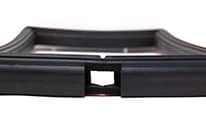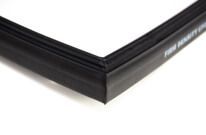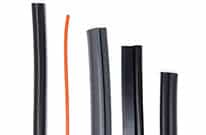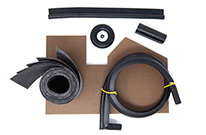
Do you need to buy rubber extrusions like edge trim, bulb trim, or sponge or solid profiles? Then don’t just compare the cost of pre-cut lengths to the cost of a coil. Buying rubber in bulk and cutting it on your shop floor might seem less expensive, but that’s because the price you pay for uncut rubber is just a fraction of your true costs.
What are those true costs? You incur them after uncut rubber arrives at your receiving dock. Think of manual labor, material waste, production delays, rework, safety hazards, and inventory inaccuracies. They all cost you money, but those amounts never appear on your purchase order or invoice.
To understand where your money is going, you need to examine Total Cost of Ownership (TCO) across direct labor, direct materials, and manufacturing overhead. It’s worth doing, because cutting rubber yourself can cut into your profitability. Keep reading to learn more and contact Elasto Proxy for cut lengths and fabricated products like finished gaskets.
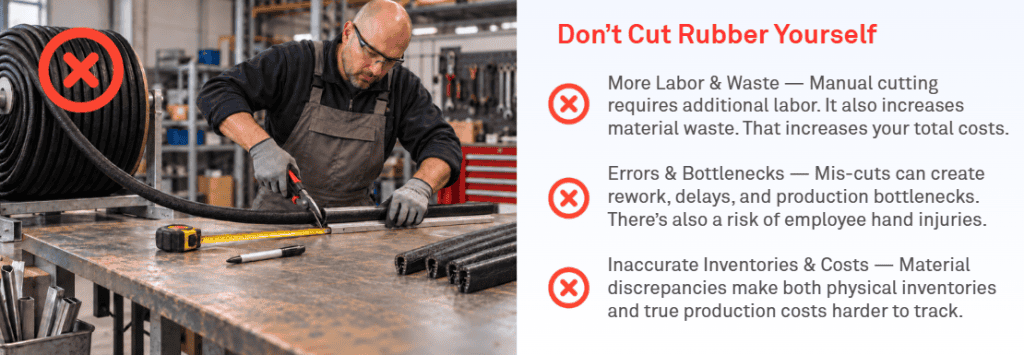
Direct Labor: More Than Just the Cut
Direct labor encompasses the wages and benefits paid to workers who physically convert raw materials into finished components. When you look at what really happens on your shop floor, however, labor is rarely limited to the few seconds it take to snip an extrusion.
Preparation and Handling Time
Before an installer ever makes a cut, workers at your facility need to:
- Locate and retrieve heavy spools or coiled boxes from warehouse storage.
- Transport coils to staging areas or assembly benches.
- Equip workstations with tape measures, marking pens, guides, and cutting tools.
- Manually uncoil, straighten, and relax rubber materials, which naturally resist lying flat because they’ve been coiled.
All these activities come with a cost, and your installer still needs to measure the rubber before ever cutting it with a hand tool.
The Inefficiency of Manual Cutting
Installers who cut rubber by hand typically use utility knives, hand shears, or chop saws. All these manual methods introduce variability. Cutting rubber requires steady pressure, and slicing through dense EPDM, reinforced edge trim, or dual-durometer profiles fatigues workers. As fatigue sets in over a shift, cutting speed slows, measuring errors increase, and inconsistencies multiply.
Rework and Assembly Bottlenecks
Manual cutting also leads to mis-cuts. An extrusion that’s cut too short won’t seal a door properly. The mis-cut becomes scrap, and an installer must measure and cut a replacement. Conversely, an extrusion that’s too long will bunch up in the corners and require trimming and test-fitting. These delays slow assembly and can create production bottlenecks that idle downstream stations.
Direct Materials: The Hidden Expense of Scrap and Yield
Direct materials include the cost of uncut rubber that becomes part of your finished assembly. When you buy rubber in coils that you cut to length by hand, you end up paying for rubber materials that only leave your shop floor when they’re sent to the landfill.
Unusable Segments
Rubber coils have unusable segments. Outer wraps can become dirty, deformed, or scuffed during shipping and handling. Inner wraps wound tightly around the spool core can suffer from permanent deformation or severe coil set, a residual coil or bow that rubber may retain after being uncoiled. If the coil set is severe enough, the material may be unsuitable for straight runs.
Then there’s end-of-coil waste. When you’re cutting set lengths from a coil that spans hundreds of feet or tens meters, there’s usually some material left over. That’s because the remainder is too short to use for another part. Unless you have some other application for this material, an installer will probably put this otherwise usable rubber in the scrap bin.
Mis-Cuts and Mistakes
Manual measuring with hand tools can’t match automated processes. If workers misread a tape measure, mark an angle incorrectly, or let the blade wander diagonally across a profile, the entire length is ruined. Over hundreds or thousands of assemblies, mistakes and mis-cuts like this can amount to many pounds or kilograms of wasted material.
Manufacturing Overhead
Beyond direct labor and direct material, manual cutting incurs manufacturing overhead costs that affect your financial reporting and introduce operational risks.
Shop Floor Safety and Hand Injuries
Cutting rubber with razor knives, utility blades, or manual shears is an occupational hazard. Because rubber compresses and deforms under pressure, blades can bind or slip and result in hand lacerations. In addition to medical treatment and potential workers’ compensation claims, workplace injuries cause downtime, incident reporting paperwork, and lowered worker morale.
Inventory Inaccuracies and Cost Tracking
Tracking linear inventory on coils isn’t easy. When assemblers pull unrecorded lengths to replace mis-cuts, your inventory amounts begin to diverge from physical reality. Material discrepancies also make physical cycle counts and project costing more challenging. Buyers may face unexpected stockouts, resulting in rush orders, expedite fees, or idled assembly lines.
Tool Maintenance and Quality Control
Maintaining cutting jigs, replacing dull blades, and calibrating shop-floor measuring equipment requires ongoing maintenance. On the shop floor, inspectors must spend time measuring cut lengths for uneven edges, improper angles, or incorrect dimensions before products ship to customers. Both types of costs help inflate your Cost of Goods Sold (COGS).
Buying Precision Cut Lengths: The Smarter Alternative
Outsourcing your cutting process and buying cut lengths from Elasto Proxy can reduce your company’s Total Cost of Ownership (TCO) for rubber extrusions. Instead of receiving raw materials that require transformation, you get standardized components that are ready for assembly. The fabrication processes that we use also improve cut-length quality.
Water Jet Precision and Complex Geometries
Elasto Proxy uses computer-controlled water jet equipment to cut rubber extrusions quickly, cleanly, and without tooling charges. Water jet cutting makes smooth, clean cuts and can create angles or chamfers without stretching or compressing the profile. Whether you need square 90° ends, 45° miter cuts for corner splicing, fastener cutouts, or notching, you’ll get consistent parts every time.
Ready-to-Install Efficiency
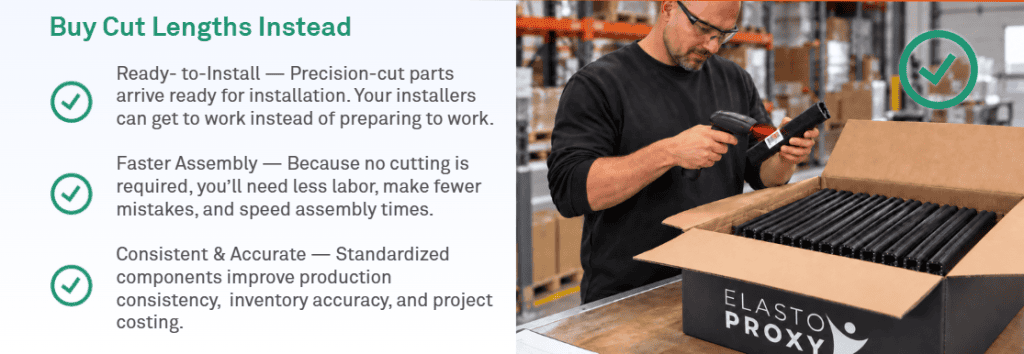
When rubber arrives pre-cut to your specifications, your installers can immediately insert, press, or bond cut lengths into place. Eliminating in-house preparation accelerates line speed, standardizes assembly cycle times, and reduces production errors. Moreover, installers can focus on what they do best: assemble your product.
Exact Costing and Inventory Control
With cut lengths, you purchase parts by piece count instead of by a bulk linear amount. The box you receive contains an exact number of parts that corresponds to an exact number of finished assemblies. This one-to-one relationship simplifies bill of material (BOM) structures, eliminates scrap and variances, and simplifies physical inventory counts.
Instead of guessing at your true costs, you can pinpoint actual component costs with precision.
Moving from Unit Cost to True Value
Is your facility still cutting lengths of rubber by hand? Then your true costs may be significantly higher than the price you see on a purchase order or the amount due on an invoice. When you consider direct labor, direct material, and manufacturing overhead coss, buying rubber coils in bulk might not be such a bargain after all.
Elasto Proxy use water jet equipment to cut rubber to length, but we also offer custom fabrication services like gasket bonding and taping for finished products that arrive ready-to-install. With our value-added service like kitting, assembly order packaging, a warehousing, your business can focus on what it does best while reducing its true costs.
Ready to learn more?