When engineers design rubber gaskets, they typically focus on material selection, durometer, compression percentage, and load vs. deflection. Yet there’s another parameter that also determines sealing success or failure. It’s called effective sealing width, and it refers to the part of the gasket that carries the sealing load.
This article from Elasto Proxy explains what effective sealing width is, why it matters, how it differs between solid and sponge rubber, and how to calculate it. As you read this article, remember that we offer design reviews in addition to custom gasket fabrication. If you’re looking for a gasket fabricator that provides greater value, contact us.
What Is Effective Sealing Width?
Effective sealing width is the part of the gasket’s cross‑section that maintains continuous contact pressure above the minimum amount required for proper sealing. In other words, it’s the part of the gasket’s total width that seals the joint when the rubber is compressed. A gasket can have a nominal width of 0.500” (12.70 mm), but the effective sealing width is less than that.
Why doesn’t effective sealing width span the entire gasket? It’s because rubber doesn’t deform uniformly when it’s compressed. As you move toward the gasket’s outer edges, the contact pressure between the gasket and the flange decreases. With some flat gaskets, the effective sealing width is 50% to 70% of the total width.
Why Effective Sealing Width Matters
Why do you need to determine the effective sealing width? It’s so you can predict the minimum sealing stress, prevent leakage under pressure, and avoid gasket over-compression. As you’ll learn later, there’s also a relationship between effective sealing width and bolt load.
Predicting Minimum Sealing Stress
Every rubber material has a minimum sealing stress: the lowest compressive stress a gasket needs to form an initial, leak-tight seal. Flat rubber gaskets are made of sheet materials that typically require a minimum of 100 to 200 psi (6.89 to 13.79 bar) sealing stress. If a gasket doesn’t reach its minimum sealing stress, it will leak regardless of material type, durometer, and other parameters.
Preventing Leakage Under Pressure
There’s more than one type of pressure to consider when you’re designing a custom rubber gasket.
Internal pressure is the pressure of the media inside a sealed system, such as a walk-in bathtub or a stainless steel tank for making beer or wine. You can think of it as the force that’s pushing outward from inside the bathtub or tank (to use our example).
What’s its relationship to effective sealing width?
A gasket with a small effective sealing width has less sealing force and a greater risk of leaks. That’s because the internal pressure reduces the contact pressure between the gasket and the flange. In a worst-case scenario, internal pressure can cause a gasket to blow-out.
Avoiding Over‑Compression
Many gaskets, especially flat gaskets, are fastened with bolts. During product assembly, installers may over-torque the bolts to reduce the risk of leakage. This can result in permanent compression set, a loss of resiliency, or extrusion that forces the gasket out of its installed location. More torque isn’t the answer here because rubber compression follows non-linear load vs. deflection curves.
Over-compression also reduces the effective sealing width. Here’s what happens.
- The center of the gasket takes almost all the load
- The edges lose contact pressure
- The sealing band collapses inward
Instead of a wide and stable sealing zone, you get a thin, overstressed band that’s prone to leakage.
Solid vs. Sponge Rubber: Differences in Effective Sealing Width
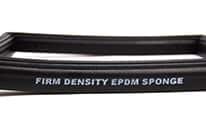
Sponge rubber contains air-filled pockets or cells. Solid rubber does not. Sponge rubber tends to be softer and more compressible. Solid rubber tends to be harder and more impact-resistant. That’s just a general overview of the differences, but here’s the relationship to effective sealing width.
- Solid rubber has a narrower effective sealing width. Typically, it’s 50% to 70% of the gasket’s nominal width.
- Sponge rubber has a wider effective sealing width. Typically, it’s 60% to 90% of the gasket’s nominal width.
There’s also a relationship between solid vs. sponge rubber, compression, and effective sealing width.
- Solid rubber concentrates the load in the center of the gasket. Avoid over-torquing the bolts but apply enough torque to generate stress across the entire effective width.
- Sponge rubber distributes the load more evenly. This makes it ideal for lower-pressure sealing, as well as for irregular surfaces and applications that require greater conformability.
How to Estimate Effective Sealing Width
You’ll need to use finite element analysis (FEA) to calculate exact values, but here’s the formula for estimating effective sealing width (Weff).
Wnom · (1 – 1/k) = Weff
Where:
- Wnom = Nominal gasket width
- k = compression stiffness factor (dimensionless)
Typical values:
- Solid rubber: k = 3 to 5
- Sponge rubber: k = 1.5 to 2.5
Example:
A sponge gasket where Wnom = 0.500” and :
0.500” · (1 – 1/4) = 0.375”
As a percentage, 0.375” is 75% of 0.500”. That’s within range for a sponge rubber gasket.
How to Estimate Bolt Load
Once you know the effective sealing width, you can use this formula to calculate the bolt load (Fbolt):
Pmin · Weff · L
Example:
- Pmin = Required sealing stress = 100 psi
- Weff = Effective sealing width = 0.375″
- L = Gasket perimeter = 20″
100 · 0.375” · 20 = 750 lbf
Choose Value-Added Gasket Fabrication
Effective sealing width is one of the most important but overlooked parameters in gasket design. Elasto Proxy can help you select the right rubber material and durometer, but we also offer design reviews. If you’re engineering a custom gasket and want to ensure your design accounts for effective sealing width, we can help.