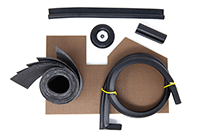
Nuclear glovebox gaskets provide sealing and insulation for nuclear gloveboxes: negative-pressure containment chambers that are used to safely manipulate radioactive or hazardous materials. Elasto Proxy makes rubber gaskets for nuclear glovebox windows, but we can also supply with you with other types of seals, gaskets, and O-rings for these containment systems.
The American Glovebox Society (AGS) recommends selecting rubber materials based on their chemical compatibility, temperature range, radiation resistance, durometer (hardness), compression set behavior, and permeation resistance. AGS-G006-2017, an AGS publication, offers guidance, and Elasto Proxy can help you with material selection and provide expert fabrication.
This article from Elasto Proxy provides an overview of nuclear glovebox gaskets. It begins by describing the main parts of a nuclear glovebox and then covers gasket materials and types. Keep reading to learn more and contact us to request a quote.
What is a Nuclear Glovebox?
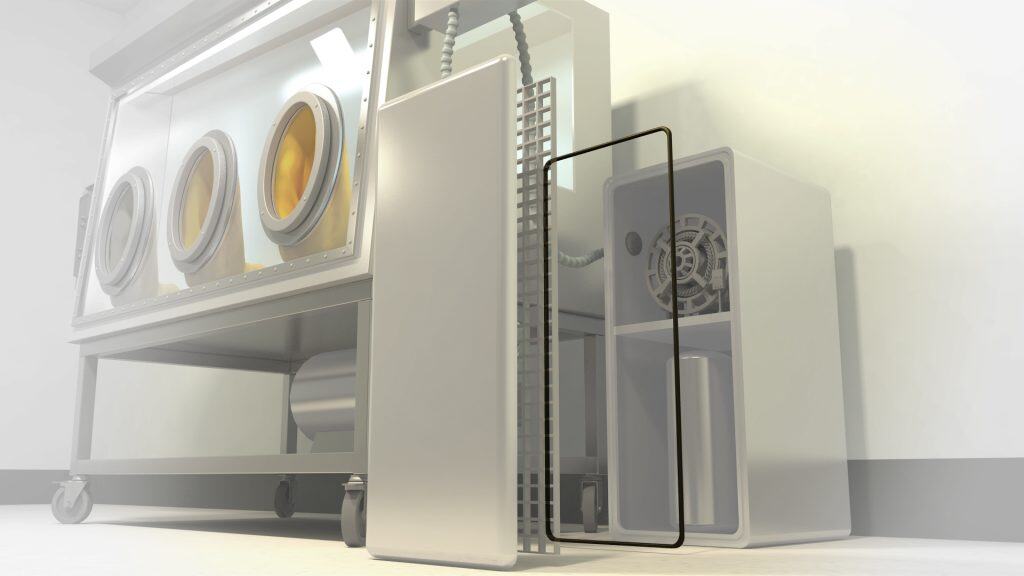
Nuclear gloveboxes are sealed containment chambers with glove-equipped ports so that personnel can handle materials without direct exposure or environmental contamination. Heavy duty rubber gloves are sealed directly onto the ports and are sometimes lead-lined. Often, the glovebox contains an inert gas such as argon to prevent chemical reactions with moisture and oxygen.
Most nuclear gloveboxes are made of stainless steel and have thick, transparent viewing panels. These windows are made of lead-loaded gas for shielding against X-rays and gamma radiation, or polycarbonate or acrylic for impact resistance and alpha ray containment. Sometimes, safety glass or combinations or plastic and glass are used.
Within the nuclear glovebox, there’s a smaller, connected chamber with inner and outer doors for transferring materials without breaking the inert atmosphere. Bag-out ports support the safe, contained removal of radioactive waste or samples. There are also sealed ports for utility feedthroughs and a high-efficiency particulate air (HEPA) filter.
Throughout the nuclear glovebox, high-integrity seals, gaskets, and O-rings are required.
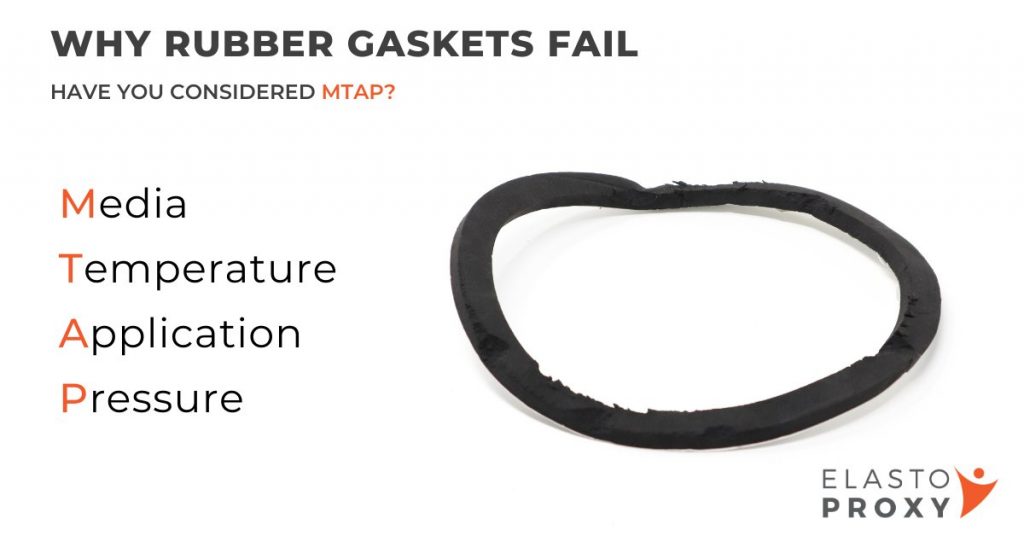
Nuclear Glovebox Gasket Materials
Gasket materials for nuclear gloveboxes include neoprene, Viton®, and EPDM. Each has advantages and disadvantages in terms of performance and cost. AGS recommends neoprene for window gaskets but does not require it. In fact, AGS-G006-2017 clearly states that “compatibility issues may require the use of other gasket materials,” including EPDM and Viton.
Neoprene Glovebox Gaskets
Neoprene is a general-purpose elastomer with good mechanical strength and moderate chemical resistance. Typical uses include legacy gloveboxes and low-hazard containment. Although neoprene is used widely by nuclear glovebox manufacturers, it’s not ideal for high radiation applications and is not recommended for use with aggressive solvents. Among its disadvantages, neoprene is susceptible to aging and ozone cracking.
Viton Glovebox Gaskets
Viton™ is a brand of highly fluorinated elastomers from Chemours that offers good radiation resistance, excellent chemical resistance, and high-temperature stability. Viton™ is relatively expensive, but it’s recommended for high-radiation gloveboxes, solvent-rich environments, and long-term static seals where the compressive force on the gasket will not be removed. Viton™ is a type of FKM, an ASTM D1418 standard for fluoroelastomers. However, Viton™ is not the only type of FKM.
EPDM Glovebox Gaskets
EPDM is a cost-effective alternative to Viton™ that offers good radiation resistance and excellent resistance to ozone, steam, and many cleaning agents. It also provides good tensile strength: resistance to breaking under tension. EPDM did not exist when neoprene became the default material for glovebox gaskets, but EPDM can withstand higher levels of radiation and is a potential alternative for new and existing gloveboxes.
Types of Nuclear Glovebox Gaskets
There are seven major types of nuclear glovebox gaskets in AGS-G006-2017.
- Flat
- Channel
- Zippered
- Gloveport
- Bagport
- Penetration
- O-Ring
Elasto Proxy can supply glovebox manufacturers with all of them.
Flat Gaskets
Flat gaskets are used with windows, access panels, service panels, and flanged connections. They’re also used with bolt-ring style bagports and gloveports. (See the sections below for more information.) Flat gaskets require smooth, flat sealing surfaces and are installed between clamping frames. The rubber products are cut from sheet materials.
Channel Gaskets
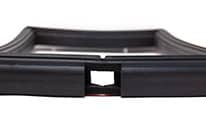
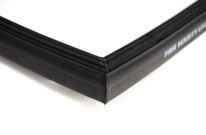
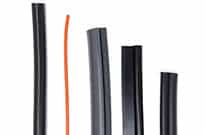
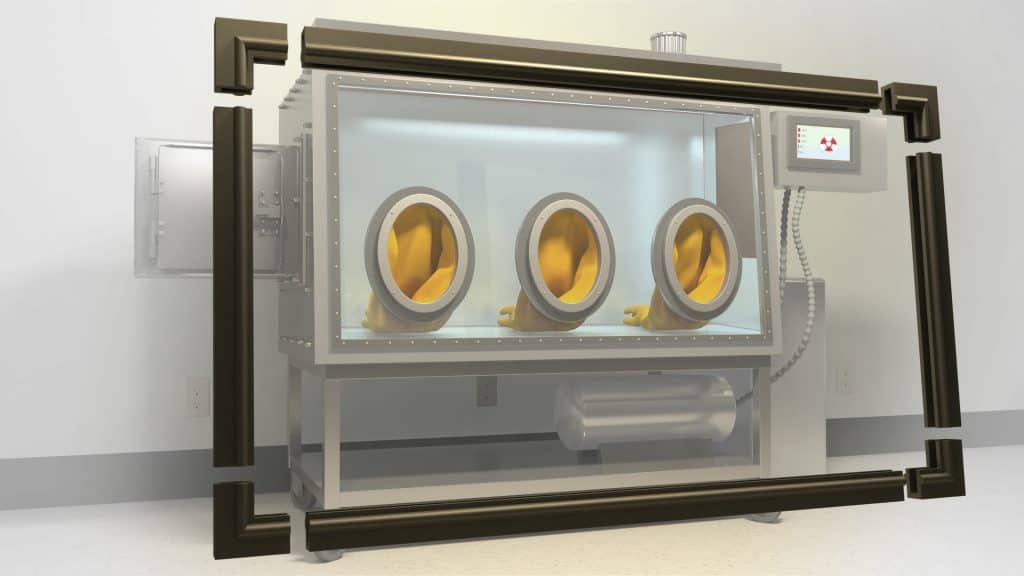
Channel gaskets span the perimeter of a nuclear glovebox window and have a groove that fits over the window’s edges. These gaskets protect edges during installation, provide uniform compression, and reduce the risk of roll-out during installation. Channel gaskets can be molded as a single piece or cut to length from extruded rubber and then bonded or molded into a finished product.
Important: See this article for a comparison of bonding methods.
Zippered Gaskets
Zippered gaskets are used for removable windows and large access panels. They have an integrated zipper mechanism that supports rapid removal and replacement. Zippered gaskets tolerate greater shell warpage than flat gaskets for clamped windows. AGS-G006-2017 provides window opening tolerances for height/width and corner radius.
Gloveport Gaskets
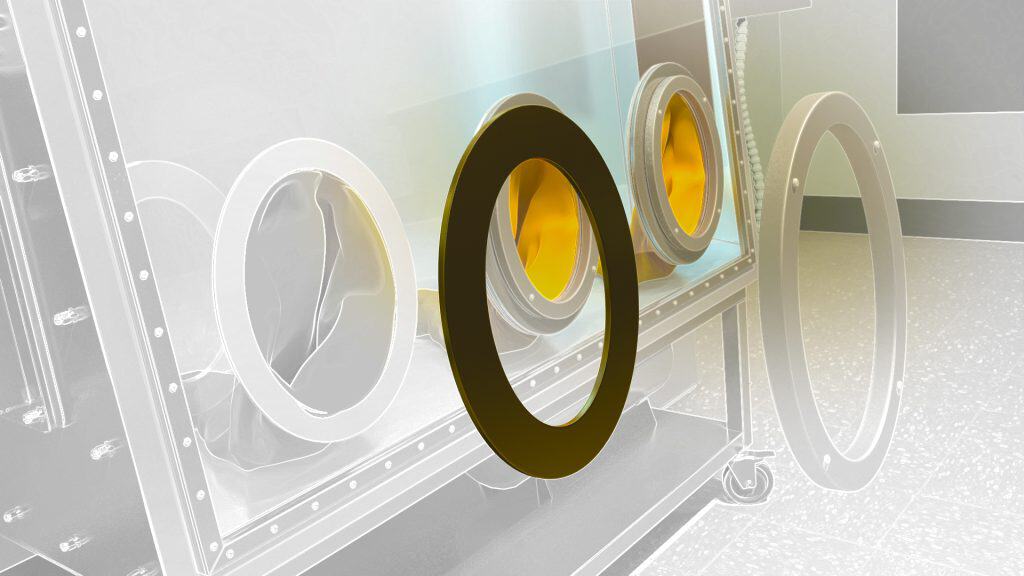
Gloveports are welded directly to the shell of a nuclear glovebox or bolted using gasketed rings. Depending on the type of gloveport, the gasket seals the gloveport hardware to the shell or seals the glove cuff to the gloveport ring. Gloveport gaskets must be free of imperfections that could damage gloves and must maintain a tight, reliable seal under glove manipulation loads.
Bagport Gaskets
Bagport gaskets are like gloveport gaskets but are optimized for the attachment and removal of plastic bags that hold contaminated tools or waste materials. Bagport gaskets are circular and must free from surface imperfections to avoid bag tearing. Gasket design needs to account for whether the bagport is welded directly to the shell or uses bolt rings.
Penetration Gaskets
In nuclear gloveboxes, penetration gaskets are used with electrical feedthroughs, instrumentation, gas pipes, fluid transfer tubes, and utility couplings. They must be compatible with the glovebox atmosphere, withstand pressure cycling and thermal loads, and meet glovebox leak-tightness criteria to ensure the containment of radioactive or hazardous materials.
O-Rings
O-rings are donut-shaped seals for pressure-rated wells, vessels, specialized access ports, and purifier system interfaces. They are designed to fit a groove and are crushed in place. Glovebox manufacturers define the groove dimensions, and O-rings require surfaces that are free from radial scratches.

Ask Elasto Proxy for Nuclear Glovebox Gaskets
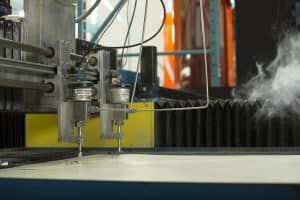
Elasto Proxy makes nuclear glovebox gaskets and can help you with material selection and design reviews. We use water jet cutting to quicky and efficiently cut rubber gaskets from sheet materials and extrusions. As a future article will explain, our one-step process for molding the corners of window gaskets is superior to the two-step process that much of the industry uses.