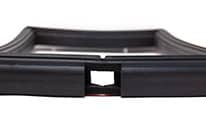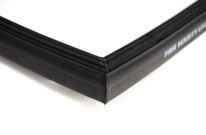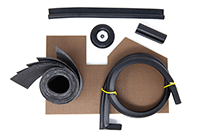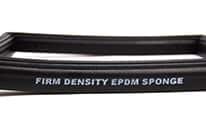
Nuclear glovebox window gaskets are radiation-resistant seals that create an airtight barrier between a containment chamber’s viewing window and window frame. Often, U-shaped channel gaskets are used. These rubber seals span the perimeter of the glovebox window and have a groove that fits over the window’s edges. Flat or zippered gaskets can be used instead, but channel gaskets protect edges during installation, provide uniform compression, and reduce the risk of roll-out during installation.
Elasto Proxy fabricates nuclear glovebox gaskets and has partnered with Paragon Energy Solutions to ensure the quality of window gaskets with molded corners, one of the fabrication methods that this article describes. Keep reading to learn more, and contact Elasto Proxy for glovebox sealing solutions. In addition to window gaskets, we fabricate gloveport gaskets, bagport gaskets, penetration gaskets, and custom O-rings.
Elasto Proxy makes nuclear glovebox gaskets, including window gaskets.
Molding and Extrusion
Channel-style gaskets for nuclear glovebox windows can be molded as a single piece or cut to length from extruded rubber and then bonded or molded into a finished product. Window gaskets that are molded in a single piece don’t require bonding, so there aren’t any joints or corners where leaks could occur. Molding is more expensive, however, and it requires a metal tool called a mold that’s used to produce the entire gasket – and only that gasket.
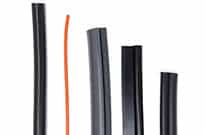
Extrusion is a manufacturing process that creates continuous lengths of rubber profiles with a fixed cross-section, such as a U-shape with a groove of a specific size. Extrusion uses a metal tool called a die, but extrusions are mass-produced so that the cost of the tool is spread across very long lengths and is not limited to a specific job, customer, or end-use project. Plus, unlike one-piece molded gaskets, extruded gaskets for nuclear glovebox windows aren’t overkill in terms of fit and function.

Water Jet Cutting
Elasto Proxy uses water jet cutting to convert coils of nitrile, Viton™, and EPDM extrusions into cut lengths. With water jet cutting, there’s no tooling to wait for or pay for. Plus, water jet equipment makes quick, clean cuts that won’t put pressure on and deform the rubber profile. These high-quality cuts support four types of bonding: PE film splicing, vulcanization, cold bonding, and molded corners. Elasto Proxy offers all these methods but recommends molded corners for reasons that you’ll now read about.
PE Film Splicing
PE film splicing uses heat, pressure, and a thin polyethylene (PE) film splice to join cut lengths of rubber extrusions. The heat source is an infrared (IR) light, and cut lengths are held together in a machine under pressure. Among its advantages, hot splicing creates strong bonds, has fast cycle times, supports high production volumes, and requires less post-production trimming. It can create nuclear glovebox window gaskets in large, complex shapes, but PE film splicing is limited to EPDM rubber.
Vulcanization
Vulcanization also involves heat and pressure, but this machine-based process joins cut lengths with uncured rubber instead of a PE film splice. The uncured elastomer is made of the same material as the gasket and applied to the ends of the cut lengths. The ends are then pressed together, and the joint is placed in a hot tool where the uncured rubber solidifies. Vulcanization can’t match PE film splicing in terms of results, but it’s good for low volumes and support nuclear glovebox window gaskets made of neoprene, Viton™, or EPDM.
Cold Bonding
Cold bonding is a manual joining process that’s performed with a brush and an adhesive or glue. It’s called “cold” because no heat is applied to the ends of the gasket. Cold bonding doesn’t require tooling or equipment, but cold bonded gaskets won’t last as long as hot spliced ones. Plus, because it’s a manual process, there’s a risk of inconsistency. Cold bonding is the quickest and lowest cost process, however, and adhesives are available for nuclear glovebox window gaskets made of neoprene, Viton™, or EPDM.
Molded Corners for Nuclear Glovebox Window Gaskets
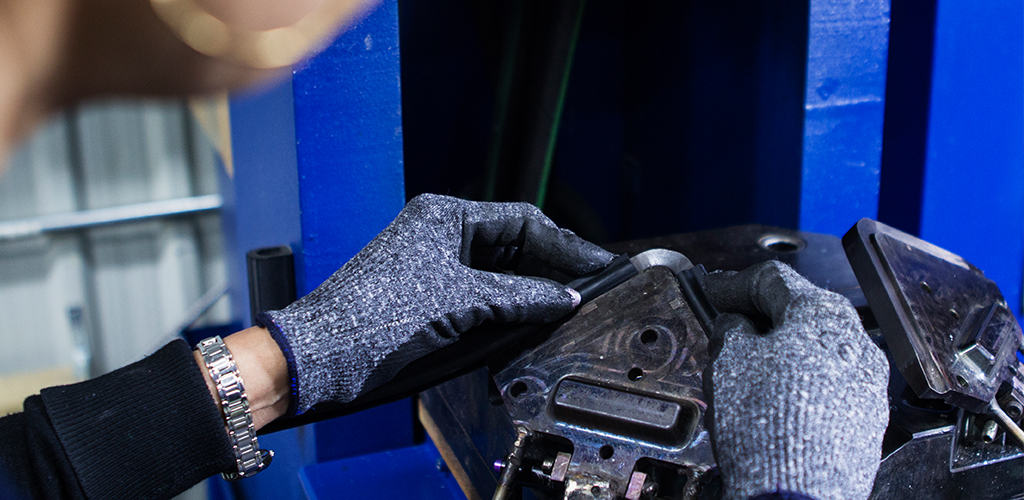
Gaskets with molded corners are not the same as molded gaskets. They’re less expensive to produce than fully molded gaskets but can still provide high-performance, airtight sealing. Plus, unlike bonded gaskets, gaskets with molded corners don’t require a two-step joining process. With molded corners, it’s possible to get nuclear glovebox window gaskets with consistent joints and without cracking and voids, all in a single step.
Gaskets with molded corners consist of lengths of extrusions that are cut to size; the ends are then molded together instead of glued, spliced, or vulcanized. By molding uncured rubber and vulcanizing it to the extrusion, the gasket’s corners are both reliable and durable. Although there’s no existing standard for molded corners on these window gaskets, Elasto Proxy and Paragon Energy Solutions have developed a four-part testing method that a future article will describe.
Ask Elasto Proxy for Nuclear Glovebox Gaskets
Elasto Proxy makes window gaskets for nuclear glovebox manufacturers and offers value-added services such as design reviews and help with material selection. Last year, we joined Paragon Energy Solutions in presenting best practices for molded corners at the annual American Glovebox Society (AGC) Conference in Lake Tahoe, Nevada. We plan to attend multiple industry events, including the 2026 AGC Conference this year, so let us if you’d like to connect.