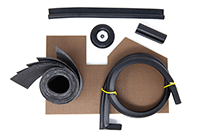
Do you need a hose connector for mobile equipment, an electric vehicle (EV), or a machine that you’re designing? Elasto Proxy serves these and other industries and supplies hose connectors, finished gaskets, custom insulation, and other rubber and plastic products to original equipment manufacturers (OEMs).
This article is designed to provide engineers with answers that can help with hose connector selection. It complements Elasto Proxy’s Ultimate Guide to Custom Silicone Connectors, where you’ll find related information such as product types and specifications. Keep reading for answers to frequently asked questions (FAQs), and contact Elasto Proxy for hose connectors.
1. What are hose connectors made of?
Engineers have a choice of hose connector materials, including liners and reinforcements. The table below describes them.
Material | Temperature Resistance | Chemical Resistance | Flexibility | Typical Use Cases |
Silicone | Excellent | Moderate | High | Coolant, charge‑air, heater hoses |
EPDM | Very good | Excellent with glycol | High | EV coolant loops, heater hoses |
NBR | Good | Excellent with oils | Moderate | Fuel and oil lines |
Neoprene | Good | Good | High | General‑purpose hoses |
FKM Liner | Excellent | Outstanding with fuels/oils | Moderate | Fuel vapor, oil‑exposed connectors |
Aramid Fabric Reinforcement | N/A | N/A | N/A | High‑pressure, high‑temp reinforcement |
Hose connectors can also use nylon fabric and metal wires. Nylon fabric is used in multi-ply hoses and metal wire is used to provide protection against extreme pressures, including vacuum pressure.
2. What advice do you have about material selection?
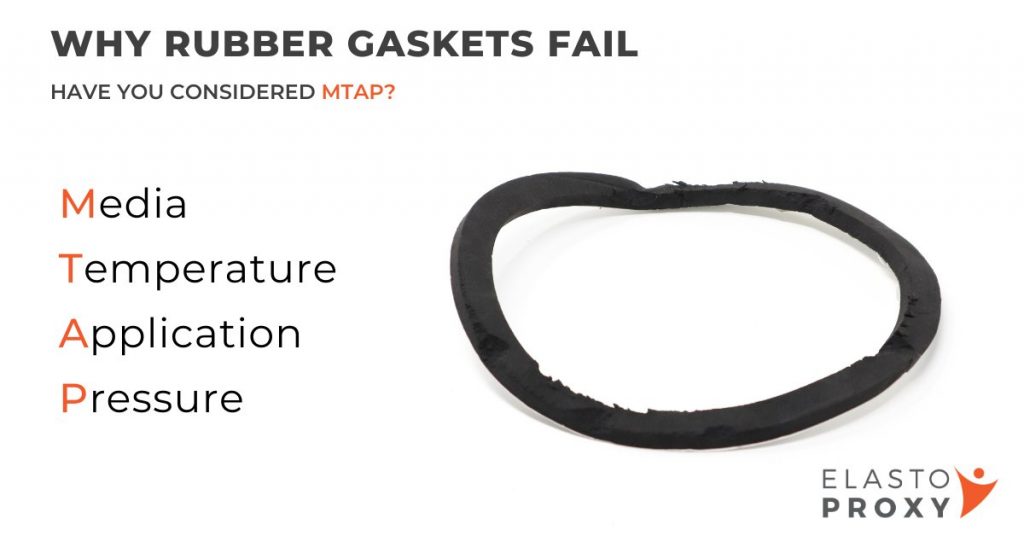
Elasto Proxy invented an acronym called MTAP to help engineers with material selection. Use it with hose connectors and with any of our industrial rubber products.
Media (M)
- Will the hose connector contact a corrosive fluid?
- Does this fluid contain glycol, petroleum, or combustible residues?
- Does you need a protective liner?
Temperature (T)
- Is the hose connector near a heat source?
- What are the continuous and peak temperatures?
- Is a high-temperature material required?
Application (A)
- Do you need a straight connector, a bent connector, or a reducer?
- Do you need a hump hose to help absorb vibrations?
- Are there space constraints that require connectors with custom angles?
Pressure (P)
- What is the working pressure: the hose’s maximum safe, continuous pressure?
- What is the burst pressure? (Typically, it’s 4x the working pressure.)
- Does you need a multi-ply reinforcement or fabric or wire instead?
3. When do you need a multi-ply product?
Multi-ply hose connectors provided added strength, durability, and pressure capability. As a rule of thumb, choose a multi-ply hose connector if:
- Working pressures exceed single-ply capacity
- Resistance to high burst pressure is required, such as in charge-air systems
- Vibration or movement demands greater structural integrity
- Thermal cycling is severe, such as with radiator or heater hoses
- The diameter is especially large
4. How do you determine the number of plys that you need?
Engineers usually determine the total ply count based on these factors.
- Working pressure and burst pressure
- Temperature exposure (high temperatures reduce material strength)
- Diameter (larger hoses need more reinforcement)
- Vibration and movement
- Vacuum conditions that could cause the hose connector to collapse
The table below connects ply count to other factors that engineers need to consider.
Ply count | Construction | Pressure Capability | Typical Applications | Notes |
1-Ply | Single fabric layer | Low | Light‑duty coolant lines | Rare in heavy equipment |
2‑Ply | Two fabric layers | Moderate | Automotive coolant systems | Not suitable for charge‑air |
3‑Ply | Three fabric layers | High | Standard heavy‑duty coolant, intake | Most common baseline |
4‑Ply | Four fabric layers | Very high | Turbo, charge‑air, high‑vibration | Preferred for diesel and off‑road |
5‑Ply | Heavy reinforcement | Extreme | Industrial, marine, large‑diameter | Often wrapped and autoclaved |
5. When do you need a 4-ply connector instead of a 3-ply connector?
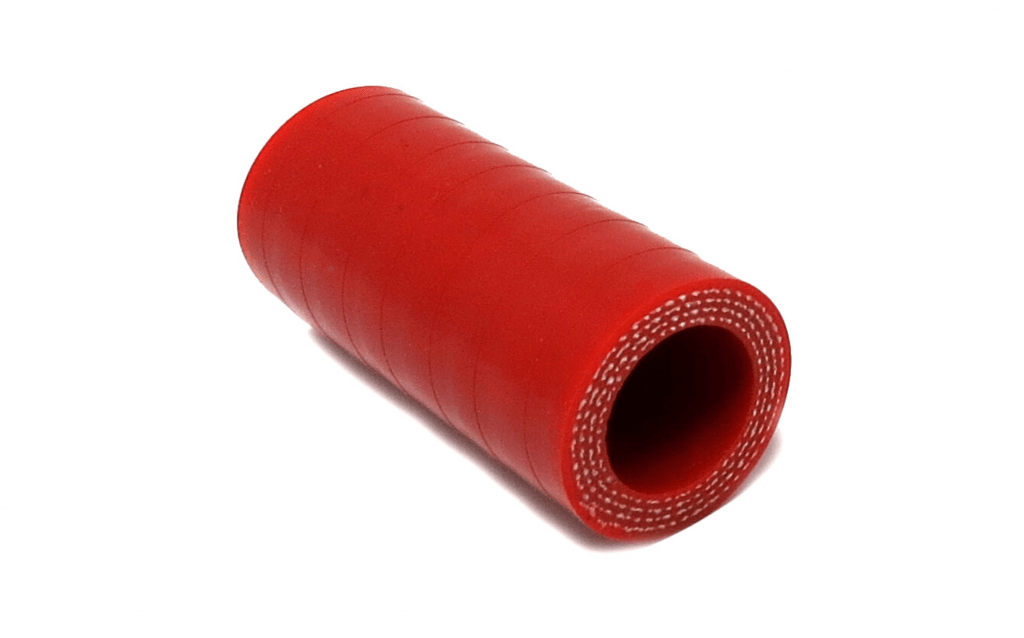
Most standard coolant and intake systems use 3-ply connectors. Charge-air, turbo, or high-pressure systems generally use 4-ply connectors (or higher) instead. In high-temperature diesel applications, 4-ply connectors with aramid reinforcements are often used.
How do you decide? Consider that a 4-ply hose connector provides the following.
- Higher burst pressure capability
- Improved fatigue resistance under thermal cycling
- Better structural stability for large-diameter hoses
- Greater resistance to vacuum collapse
- Improved durability for turbocharged or high-boost systems.
6. Is there a relationship between material selection and ply count?
Yes, but engineers also need to consider the application and any special requirements. The table below recommends ply count based on various factors.
Application | Recommended Material | Recommended Ply Count | Special Requirements |
Diesel Charge‑Air | Silicone and aramid | 4‑ply | High boost, vibration |
EV Battery Cooling | EPDM or low‑permeation silicone* | 2–3 ply | Tight tolerances, low permeation |
Hydraulic Return Lines | NBR or CR | 2–3 ply | Oil resistance |
Turbo Inlet | Silicone | 3–4 ply | Vacuum resistance (wire optional) |
Large‑Diameter Coolant | Wrapped silicone | 4–5 ply | Autoclaved construction |
* Standard silicone is inherently porous. Low permeation silicone is specially formulated, to restrict the passage of gases, moisture, and volatile compounds.

7. What’s a wrapped hoses and when do you need one?
Wrapped hoses are made by wrapping nylon fabric around an uncured hose that is then autoclaved. They retain visible textile ridges after curing and are used in heavy-duty and off-road applications. Wrapped hoses resist abrasion, withstand higher temperatures, and can support larger diameters.
8. Why are some hoses autoclaved, and what are they used for?
Autoclaving is a curing process that applies heat and pressure to consolidate layers and ensure dimensional stability. With wrapped hoses, autoclaving bonds fabric layers to the hose (and to each other) to achieve final strength. Applications include large-diameter industrial hoses, high-pressure coolant systems, heavy-duty off-road equipment, and charge-air and turbo systems.
9. What are the main standards for hose connectors?
There are several industry standards, but you’ll need to determine which apply to your application.
- SAE J20 R1 / R1 H.T. Class A – Silicone coolant and heater hose performance requirements
- SAE J1726 – High‑temperature hose specifications
- TMC RP303B (Grade I & II) – Heavy‑duty coolant hose guidelines
- Mil‑Spec A‑A‑52426 – Military hose performance requirements
- OEM‑specific standards – Heavy‑equipment and automotive manufacturers often require proprietary validation
Note: Hydraulic hose connectors follow SAE hydraulic standards for fittings, hoses, and system compliance.

10. Do heavy equipment and EV hose connectors have different requirements?
Yes, they do. The table below describes them.
Factor | Heavy Equipment | EVs |
Primary Media | Coolant, charge‑air, hydraulic oil | Coolant (glycol blends), refrigerant |
Temperature Range | Very high (turbo, exhaust proximity) | Moderate but continuous thermal cycling |
Pressure Requirements | High boost pressure, vibration loads | Lower pressure but strict permeation limits |
Material Preference | Silicone, aramid‑reinforced, wrapped | EPDM, silicone, low‑permeation elastomers |
Environmental Exposure | Dirt, abrasion, shock loads | Clean environment, tight packaging |
Design Priorities | Durability, burst strength | Dimensional stability, leak-free cooling. |
Ask Elasto Proxy for Hose Connectors
As you’ve learned from this article, Elasto Proxy supplies hose connectors and has the technical knowledge and application expertise to help you with material selection. To request a quote or discuss your application, talk to our team.